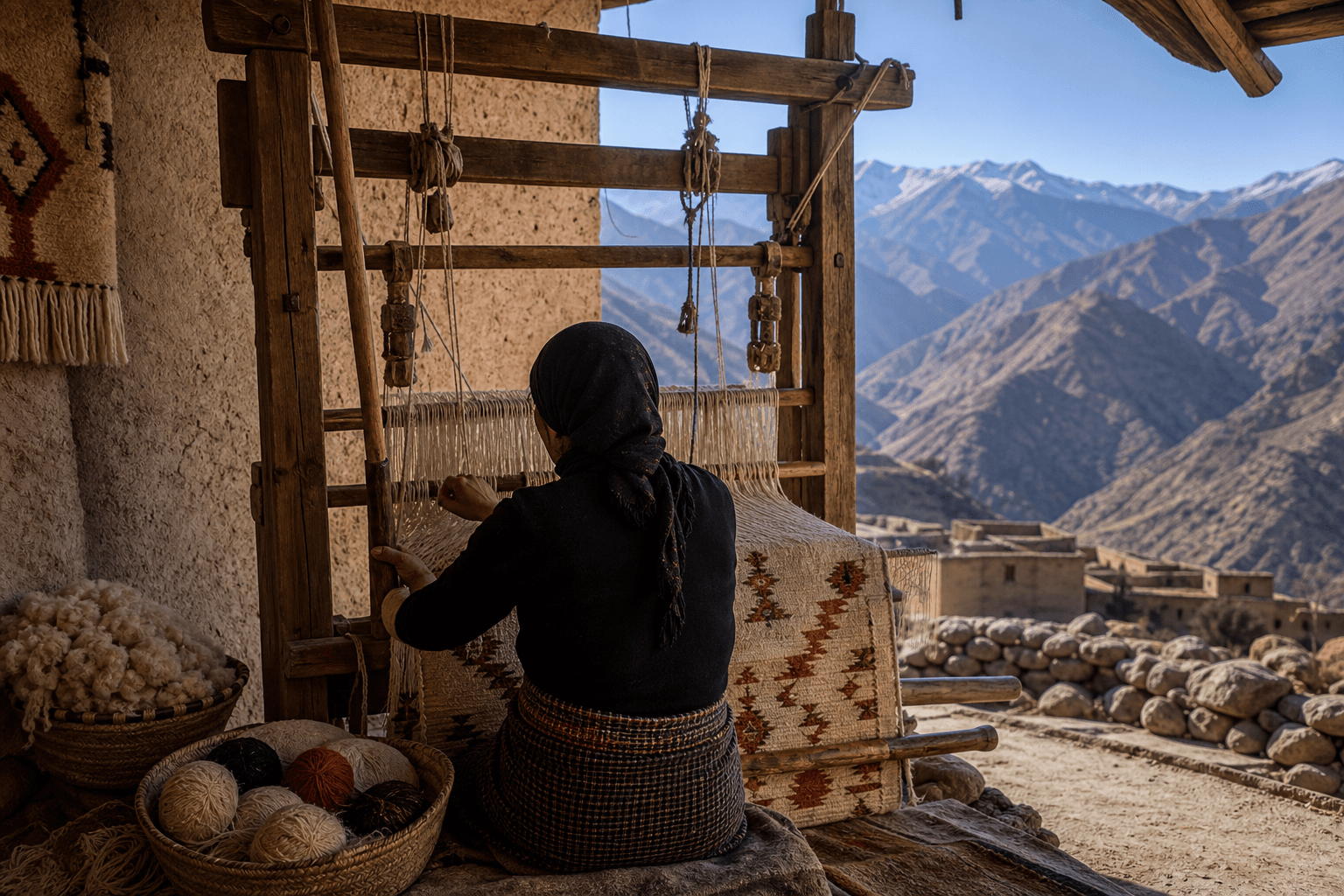
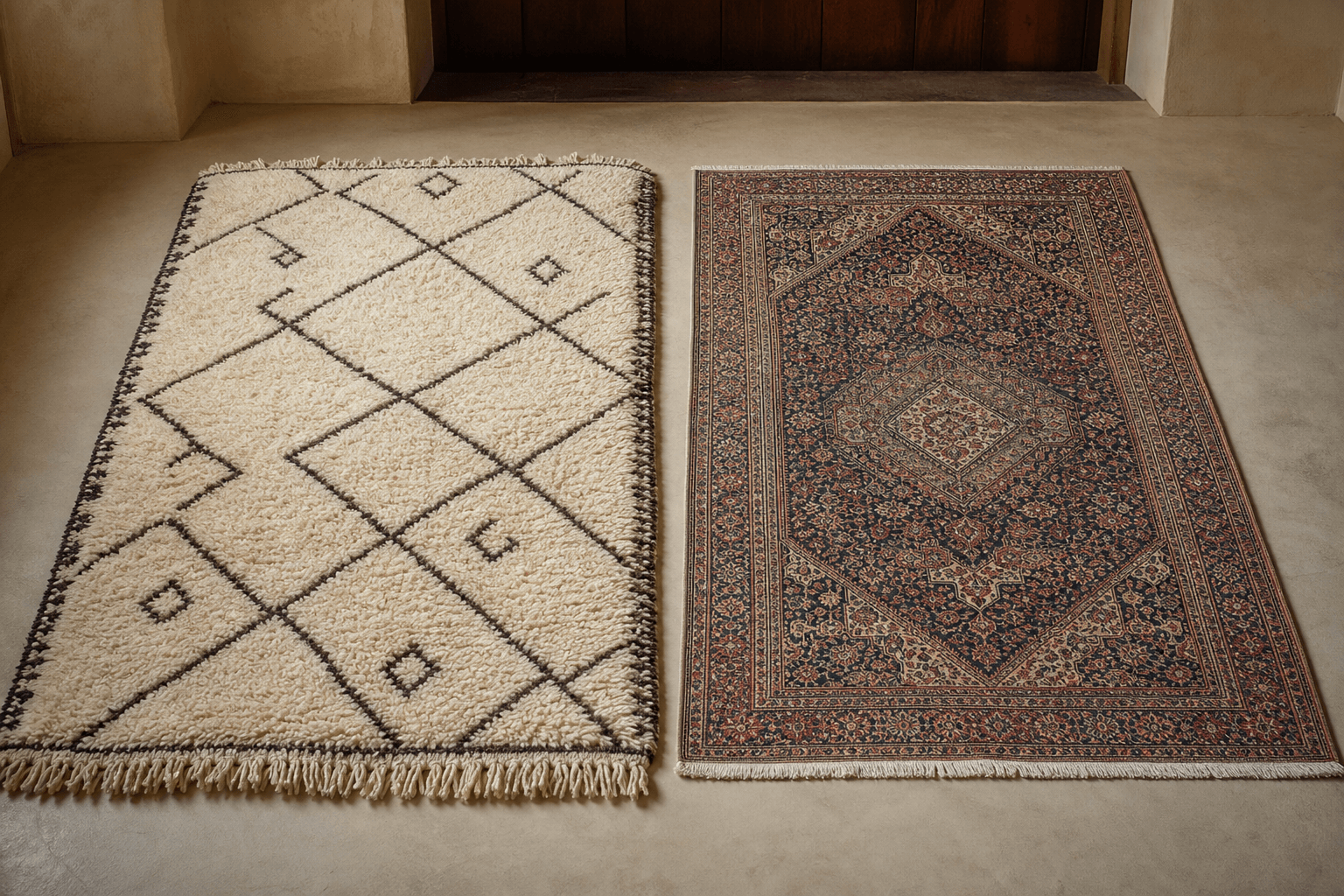
Moroccan and Turkish rugs come from many regional, urban, village, and workshop traditions; neither label describes one look. Broadly, many Atlas-associated Moroccan rugs use expressive geometry, generous wool pile, and open fields, while many Turkish carpets are known for denser patterned fields, defined borders, and fine knotted structures. Origin, technique, and specific region matter more than stereotype.
The essential difference
Compare traditions, not mood boards.
Ask where the rug was made, by whom or in what workshop, from which fibers, with which structure, and whether it is new, vintage, or antique. “Moroccan style” and “Turkish style” describe appearance; they do not prove origin.01 · Diversity
Why the country labels are only a beginning
Morocco includes Atlas mountain, rural, and urban weaving histories. A nineteenth-century Rabat carpet in The Metropolitan Museum of Art, for example, is described as an urban wool carpet with symmetrically knotted pile whose elongated format responded to long, narrow Moroccan rooms. That object differs sharply from the high-pile ivory rugs many contemporary shoppers associate with Morocco. One national adjective contains multiple structures and design languages.
Turkey likewise includes court, urban, village, and nomadic traditions across Anatolia and beyond. The Met’s late-fifteenth-century Star Ushak carpet was woven in western Turkey for regional use and European export, with wool warp, weft, and symmetrically knotted pile. Other Turkish rugs may be small village pieces, prayer formats, flatweaves, or finely patterned workshop carpets. Avoid treating one famous category as the whole.
“Berber rug” and “kilim” also answer different questions. Berber is an older English-language label often applied broadly to Amazigh people and weaving; many institutions and makers now prefer the more specific term Amazigh where it is accurate. Kilim describes a flatweave technique found across several regions, not a synonym for every Turkish rug. Use the seller’s terminology only when provenance supports it.
02 · Comparison
How do construction and appearance often differ?
| Feature | Many Moroccan traditions | Many Turkish traditions |
|---|---|---|
| Pile and surface | Ranges from high, irregular wool pile to flatweave | Ranges from fine knotted pile to flatwoven kilim |
| Composition | May use open fields, bold lozenges, asymmetry, or spare marks | May use central medallions, repeating fields, prayer formats, and defined borders |
| Color | Undyed neutrals and saturated local palettes both occur | Madder reds, blues, creams, and complex palettes occur across traditions |
| Scale | From small domestic pieces to long urban formats | From small village rugs to large workshop and court carpets |
| Best evidence | Origin, community or workshop, material, structure, age | Origin, region or workshop, material, knot/flatweave, age |
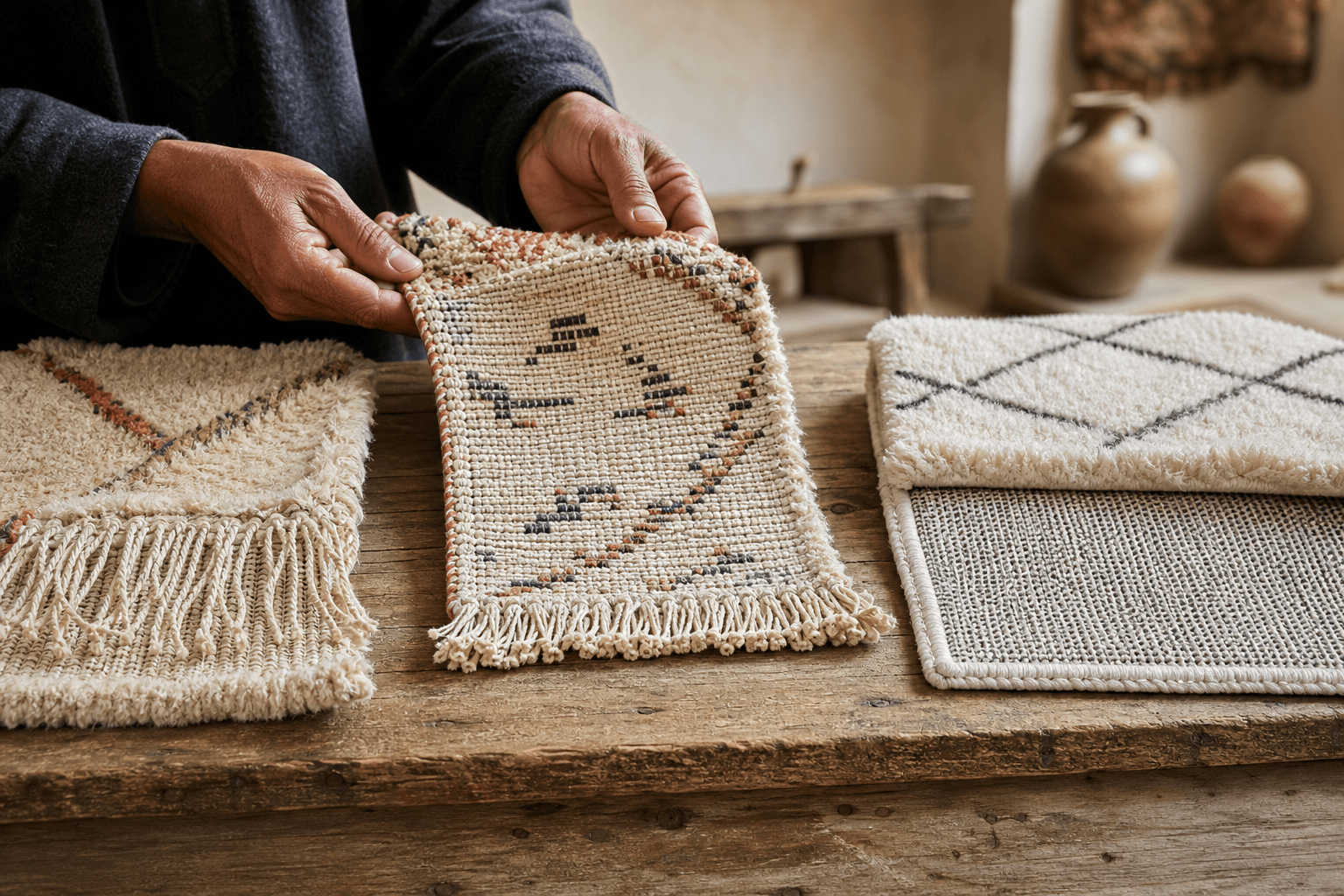
These are tendencies, not authentication rules. A cream diamond rug is not automatically Moroccan, and an intricate bordered carpet is not automatically Turkish. Reverse photographs, structural description, country of origin, age, seller expertise, and documented provenance matter more than familiar visual shorthand. Use the construction comparison guide to examine what the reverse can reveal.
03 · Room feel
Which feels right in a modern room?
A high-pile Moroccan rug often adds mass, warmth, and acoustic softness. Spare geometry can hold a modern room without competing with art or furniture; a saturated Boujad-associated palette can provide the room’s strongest color. A finely patterned Turkish rug often reads as a detailed plane, bringing border, rhythm, and historical density beneath simpler furniture. Both can work in minimal or layered interiors.
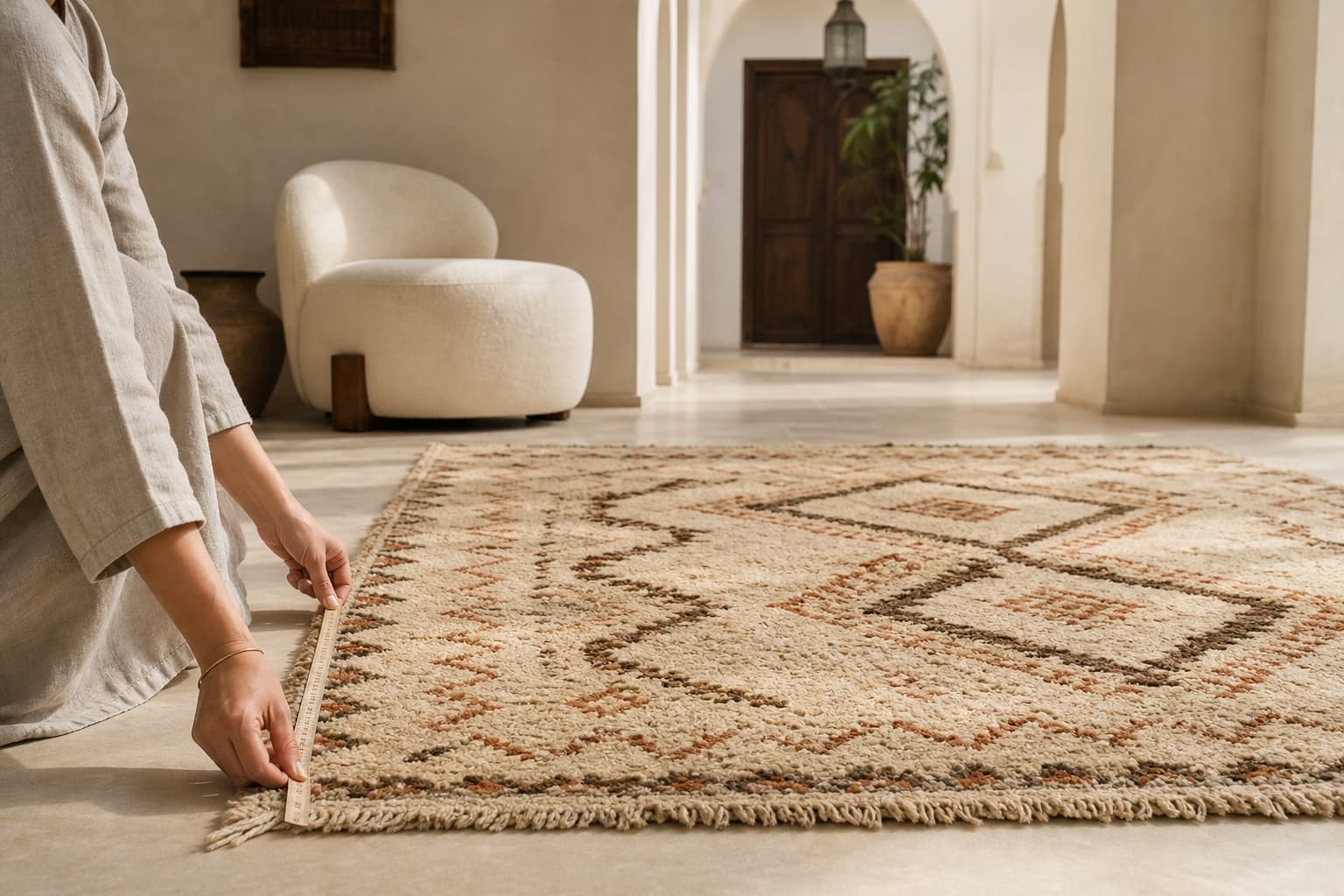
Let material guide placement. Plush pile rewards barefoot rooms and seating areas but needs thoughtful vacuuming and chair clearance. Fine low pile can sit more easily beneath dining chairs, in entries, or under furniture with lower clearance. Flatweaves are compact and often need a grippy pad. The correct size and movement pattern remain more important than nationality.
Do not create a themed room around the rug’s country. Pair wool with architecture already present—plaster, timber, stone, metal, linen—and repeat one minor color elsewhere. The object should belong to the room as a textile, not serve as a prop for an imagined geography. See how Moroccan rugs work in modern interiors for palette-led examples.
04 · Provenance
What should an honest seller be able to explain?
- The country and, when documented, the region, community, city, or workshop.
- Whether the piece is new, vintage, antique, restored, or newly made in an older style.
- Pile, foundation, backing, fiber, dye information when known, and exact construction.
- Dimensions, condition issues, repairs, odors, moth activity, color movement, and edge stability.
- The basis for any named tribal, village, symbolic, or age attribution.
Motif meaning deserves special caution. A lozenge, hook, hand-like form, star, or tree may carry local, personal, protective, religious, or decorative associations, but one universal internet glossary cannot authenticate the maker’s intention. Ask for the source of the interpretation and distinguish documented scholarship from later storytelling.
Each LEOS Atlas I product is described as made in Morocco and accompanied by a certificate of origin. The product records do not assign undocumented village or tribal identities to the designs. That restraint is useful: provenance should become more specific only when evidence supports it.
05 · Choose
Choose by object, then understand the tradition
Begin with the practical object: exact size, structure, pile, material, condition, care, and relationship with the room. Then ask whether its origin and history are documented with enough precision to justify the story and price. A beautiful rug can be honestly sold as “Moroccan style” or “Turkish style” when that is the truth; the problem is style presented as provenance.
If you prefer deep wool, open geometry, and a surface that changes strongly with light, explore Moroccan high-pile traditions. If you prefer a detailed field, clear border, finer articulation, or flatwoven surface, explore the relevant Turkish traditions. But let a specific rug overturn the generalization. The best comparison ends with better questions, not a winner.
06 · Shopping scenarios
How do common shopping comparisons change the answer?
Moroccan high pile vs Turkish low pile for a dining room
Begin with chair movement, not origin. A finer low pile may let chairs slide more easily and keep crumbs near the surface, while plush wool can make frequent movement difficult. Yet a low-pile Moroccan rug or a Turkish flatweave may reverse the assumed comparison. Select the structure and dimensions first, then the tradition.
Neutral Moroccan rug vs patterned Turkish rug for a minimal salon
A pale open field preserves visual quiet and emphasizes texture. A detailed bordered carpet can provide the one layer of historical density that prevents minimal furniture from feeling anonymous. Photograph both options in grayscale: if the room lacks tonal structure, either a dark detailed field or a stronger Moroccan medallion may solve more than another cream surface.
New Moroccan rug vs vintage Turkish rug
This is as much a condition comparison as a cultural one. A new rug offers a current product record and unused structure; a vintage rug carries wear, repairs, softened dye, and previous care that must be documented. Ask what restoration occurred, whether the rug was reduced or rebound, and how age affects safe daily use.
Online marketplace vs specialist seller
A marketplace can offer breadth and competitive pricing, but expertise and return logistics vary by individual seller. A specialist should offer better attribution, condition reporting, and care knowledge, but the title alone is not evidence. Compare the actual photograph set, written record, independent reputation, payment protection, freight terms, and willingness to answer structural questions.
In every scenario, avoid asking which country makes “better” rugs. Ask which specific object is correctly described, structurally appropriate, visually right for the room, and supported by enough evidence to justify its story and price. That question respects the range within both traditions.
Care should enter the comparison before purchase. Ask whether controlled suction is appropriate, whether the fringe needs separate handling, which pad suits the floor, and who can wash the rug locally. A regional label cannot answer those questions; the individual fiber, dye stability, pile, foundation, backing, age, and repair history can. Keep the instructions with the provenance record.
When possible, view comparable rugs in person before ordering online. Handling examples teaches the difference between plush and firm pile, fine and coarse foundation, attached and structural fringe, and light or dense visual fields. The in-person object need not be the final purchase; it gives your eyes and hands a more reliable vocabulary for interpreting photographs.
The comparison principle