Hand-knotted, hand-tufted, and machine-made rugs are not three grades of the same object. They are different structures. Hand-knotted pile is tied around a foundation one knot at a time; hand-tufted yarn is punched through a backing and usually secured with adhesive; machine-made pile is formed mechanically. The right choice depends on the room, budget, desired feel, maintenance, and how long you expect the rug to remain repairable.
The short answer
Turn the rug over.
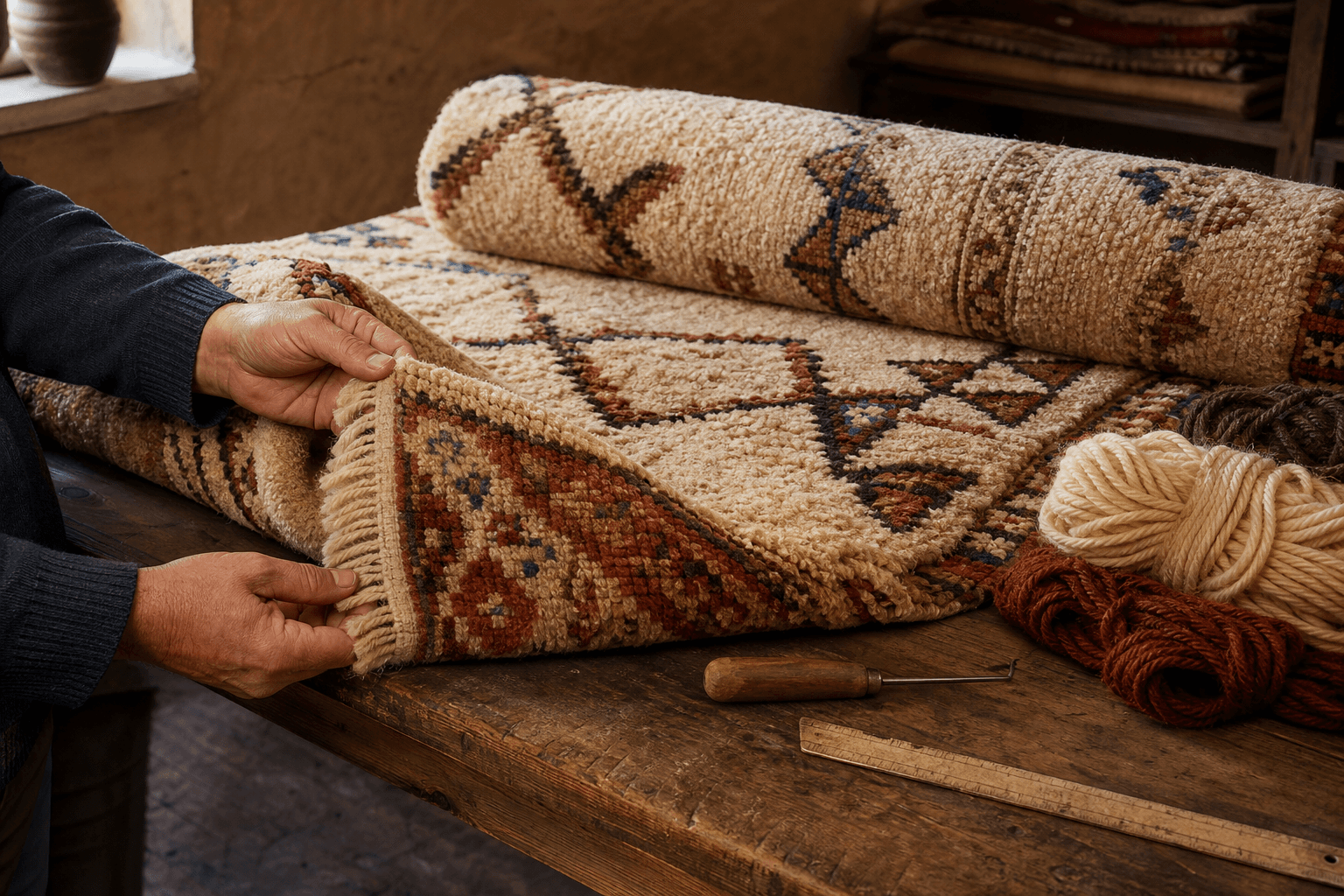
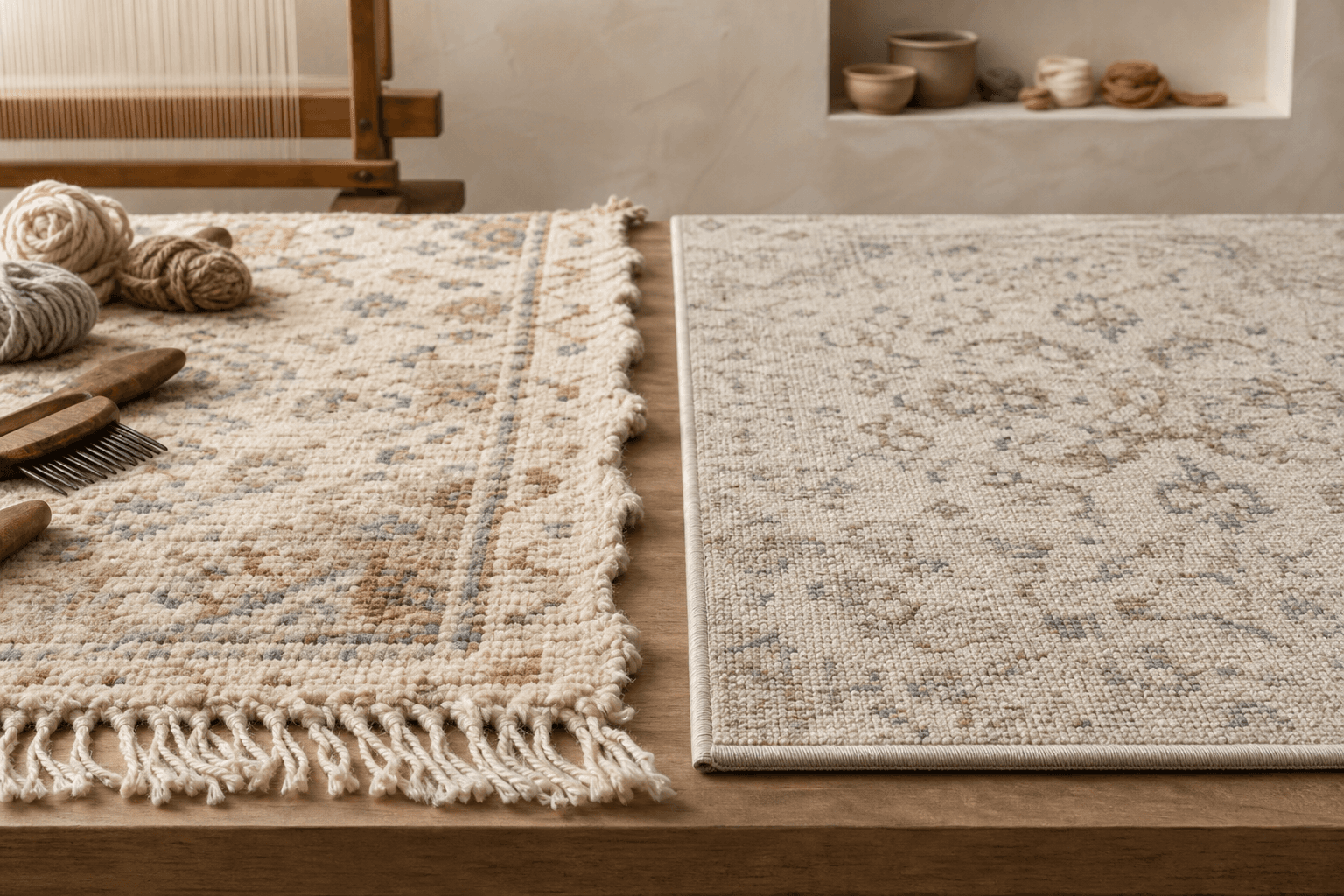
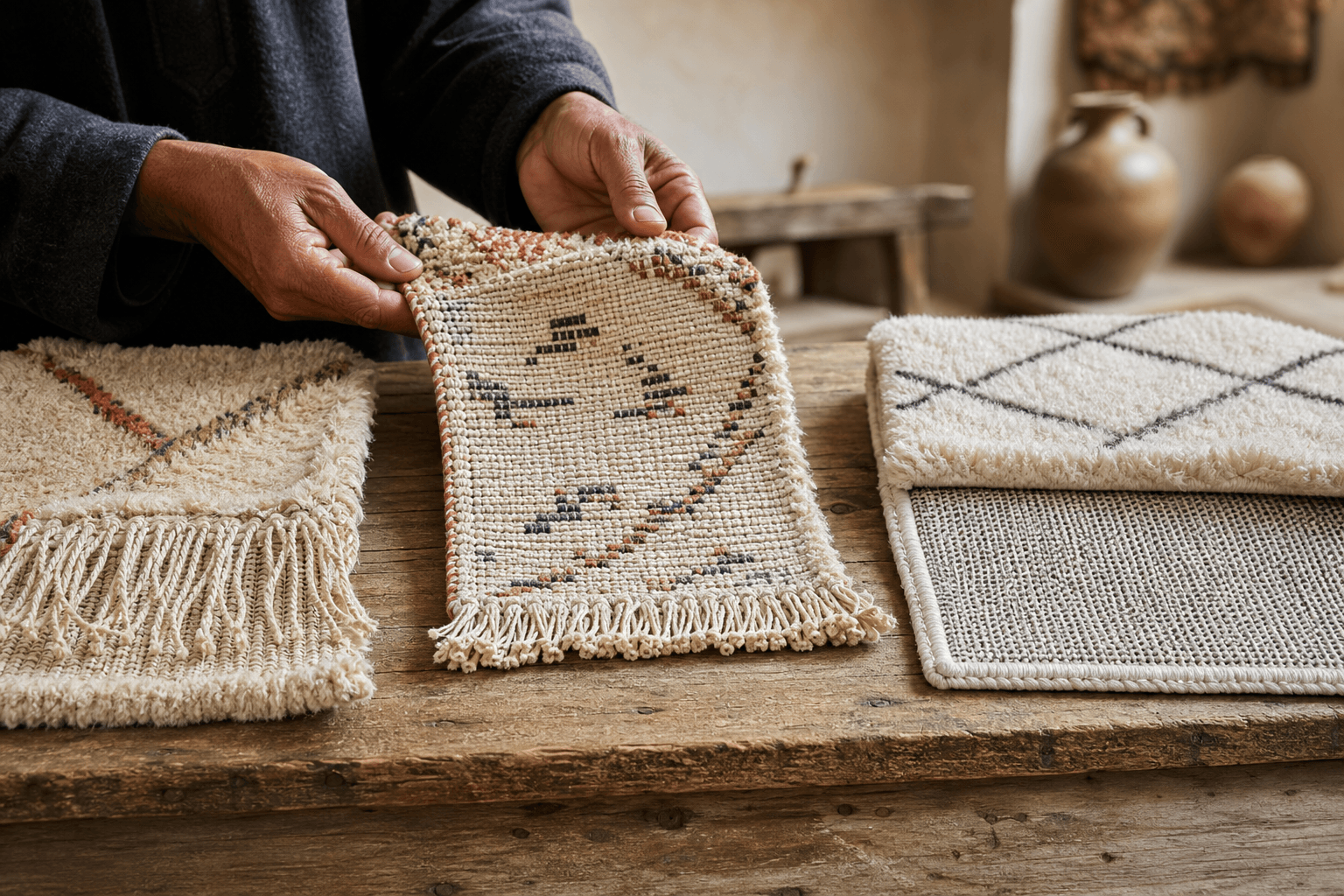
The reverse usually tells you more than the surface. A hand-knotted rug reveals the design in its woven foundation and its fringe often continues from the warps. A hand-tufted rug commonly has a fabric or latex-backed reverse. A machine-made rug shows a highly regular grid, uniform edge finishing, and repeated mechanical precision.01 · Construction
What changes beneath the pile?
A pile rug begins with a foundation: lengthwise warps held under tension and crosswise wefts that stabilize the structure. In a hand-knotted rug, the maker ties or loops pile yarn around selected warps, secures each row with weft, and cuts the pile to its intended height. Pattern and structure grow together. The Metropolitan Museum of Art’s technical descriptions of historic pile carpets distinguish foundation, weft passes, knot type, and pile because those details—not a vague “handmade” label—explain how the textile is built.
Hand-tufting uses a handheld or powered tufting gun to push yarn through a prepared primary backing. Adhesive is normally applied to hold those tufts, then a secondary cloth covers the reverse. A person still guides the design, so “hand-tufted” is genuinely hand-involved, but it is not hand-knotted. Machine-made rugs are produced on powered looms in repeatable runs; fiber, weave, and backing vary widely, from practical flat indoor-outdoor constructions to dense woven pile.
| Feature | Hand-knotted | Hand-tufted | Machine-made |
|---|---|---|---|
| How pile is formed | Knots or loops worked into the foundation | Yarn punched through backing | Pile formed mechanically |
| Typical reverse | Design visible in the woven structure | Secondary fabric over adhesive | Regular mechanical grid or backing |
| Fringe | Often continuous with foundation warps | Usually attached or decorative | Usually attached or machine finished |
| Variation | Small shifts in line, pile, and tension | Some hand-guided variation | High repeatability |
| Repair outlook | Often locally repairable by a specialist | Depends on backing and adhesive condition | Depends on fiber, weave, and available matching material |
02 · Inspection
How can you identify construction online?
Start with six photographs: full front, reverse, edge, fringe, pile close-up, and the rug in a room. A seller who only shows a styled interior leaves the construction impossible to verify. On a hand-knotted piece, look for the motif on the reverse, the path of the foundation into the fringe, and slight human variation that remains coherent across the object. Irregular does not mean damaged; a torn foundation, loose edge, exposed backing, or powdering adhesive is a different matter.
Do not use knot count as a universal score
Knot density can support very fine drawing, but it should be read within a weaving tradition. A bold high-pile Atlas rug and a finely articulated urban carpet solve different visual and tactile problems. Compare wool quality, stability, edge finishing, pile consistency, and suitability for the intended room before turning one number into a verdict. Our online quality checklist explains what to request before purchase.
Ask the seller to name every layer
Request the pile fiber, foundation fiber, backing, adhesive if present, country of origin, and technique. “Wool rug” may describe only the visible pile while the foundation or backing uses other materials. Specificity makes care advice more reliable and gives a future repair specialist useful information. LEOS product records state natural wool, dimensions, palette, making, and provenance instead of asking a mood photograph to carry the entire claim.
03 · Feel and use
Which construction belongs in which room?
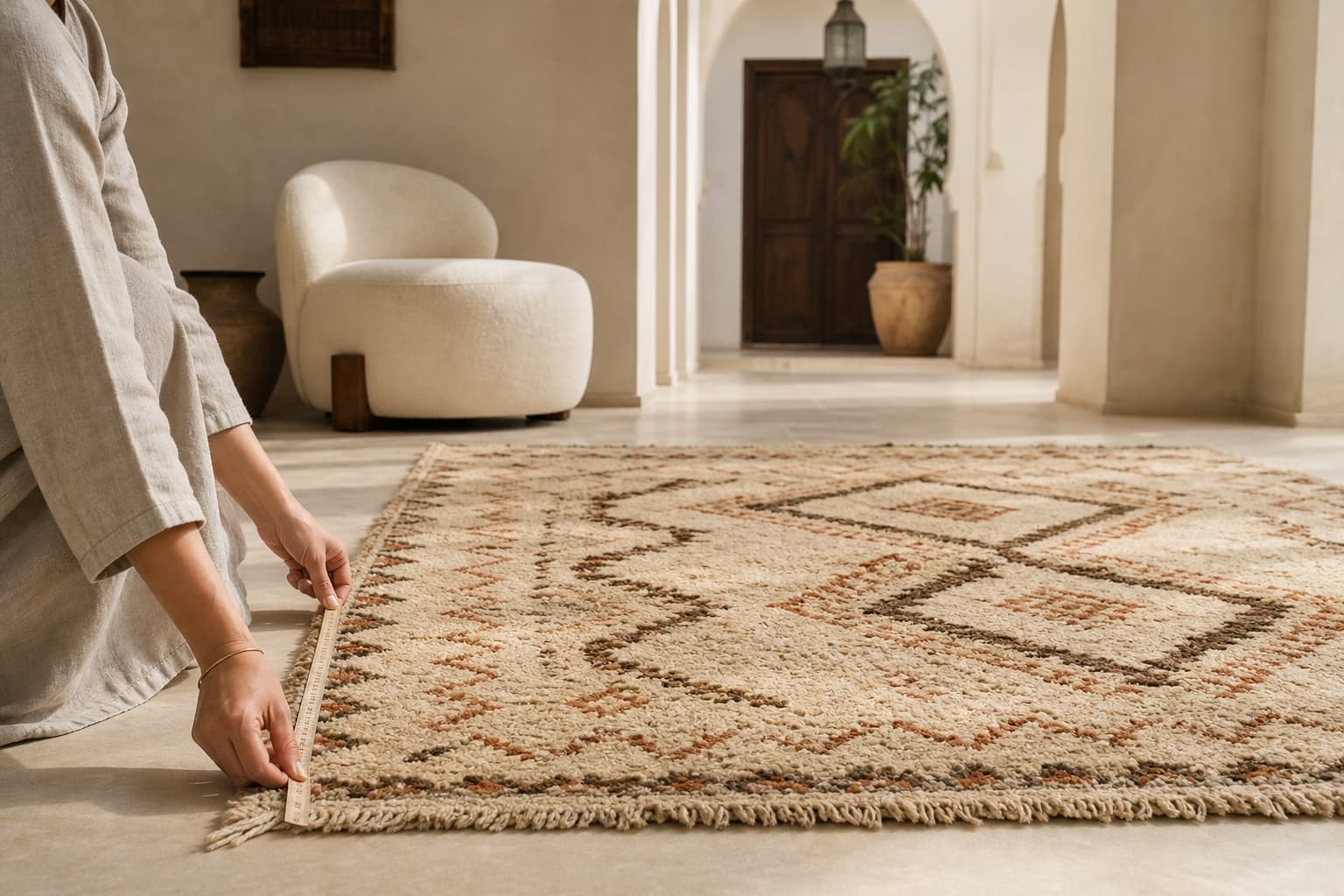
Construction affects behavior, but pile height, fiber, density, and rug pad matter too. A plush hand-knotted wool rug can feel warm and generous in a living room or bedroom. A lower, firmer pile may make dining chairs easier to move. A flat machine-woven rug can be a rational choice beneath a rolling office chair or near a doorway with little clearance. A washable synthetic construction may suit a household that values quick machine cleaning above long-term repair.
Match the object to real movement. Test door swing, furniture weight, children, pets, sunlight, and the cleaning routine you will actually follow. The room-by-room size guide handles proportion; the wool rug care guide explains suction-only vacuuming, rotation, and specialist washing. Neither beauty nor price compensates for a construction that frustrates daily life.
- Choose hand-knotted wool when tactile character, one-of-one variation, and specialist repair matter.
- Choose hand-tufted when you want a hand-guided design at a lower production cost and accept a backed structure.
- Choose machine-made when consistency, repeat availability, easy replacement, or a specific performance fiber leads the decision.
04 · Longevity
What determines whether a rug lasts?
No honest lifespan can be assigned from the construction label alone. Wool quality, foundation, knot or tuft security, traffic, grit, sunlight, spills, humidity, pad, and cleaning method all shape wear. A poorly made hand-knotted rug can fail early; a well-specified machine-made rug can provide many useful years. The stronger question is whether wear can be stabilized and whether repair remains proportionate to the value of the object.
Hand-knotted rugs often allow a specialist to rebuild a small foundation area, re-knot missing pile, or secure an edge because the structure is accessible. A tufted rug may be repairable, but aging adhesive and secondary backing can complicate the work. Machine-made repair depends on the weave and matching fiber. Before buying, ask who could repair the rug, what care invalidates a warranty, and whether the seller keeps a permanent record of materials and origin.
05 · Decision
Buy the named structure, not the atmosphere
Construction should be written plainly on the product page and invoice. If “handmade,” “handwoven,” “hand-knotted,” and “hand-tufted” are used interchangeably, pause. Ask for the reverse, material composition, country of origin, exact dimensions, care instructions, return terms, and a direct explanation of the technique. These questions are not a test of luxury vocabulary; they are the minimum record needed to understand what you are buying.
Then choose without hierarchy. A hand-knotted rug is valuable when its material presence, human variation, and repairable structure matter to you. A hand-tufted or machine-made rug may be more suitable when budget, repeated sizing, washability, or rapid replacement matters more. The best construction is the one accurately described and properly matched to the room.
06 · Common mistakes
Which shortcuts lead to the wrong conclusion?
Assuming every visible irregularity proves handwork
Machine-made rugs can be designed with uneven-looking lines, abrash-like color, distressed printing, or clipped pile intended to imitate age. Hand-tufted patterns can also look spontaneous on the face while a secondary backing hides the construction. Authentic identification comes from the relationship between face, reverse, edge, fringe, foundation, and seller record—not one charming imperfection.
Assuming a visible design on the reverse proves hand-knotting
Some mechanically woven rugs display a clear reverse pattern, and some handmade flatweaves show the design on both sides without using knotted pile. Ask how the pile is attached and look at the actual foundation. A knowledgeable seller should be able to describe warp, weft, pile, backing, and finishing in plain language. When the structure is difficult to classify from photographs, request a short video that moves from the face to the reverse without a cut.
Confusing attached fringe with deception
Attached fringe is normal for many constructions when accurately described. It becomes misleading only when it is used to imply that the tassels continue from a hand-knotted foundation. Inspect where fringe meets the edge and ask whether it is structural or decorative. The answer influences repair and care, not the rug’s right to be useful or beautiful.
Buying for a category instead of a household
A buyer can correctly identify a hand-knotted rug and still choose poorly. Deep pile may block a door, a pale field may create anxiety in a high-spill zone, or a rare object may be too precious for the desired daily use. Conversely, a mass-produced rug chosen for easy replacement may disappoint if tactile wool and long-term repair were the real priorities. Write the room brief before comparing constructions.
The final safeguard is documentation. Save product photographs, specifications, invoice, care instructions, certificate, and seller correspondence. If the rug later needs cleaning, appraisal, insurance, or repair, that record helps the next expert understand what cannot be learned from the surface alone.
The construction rule