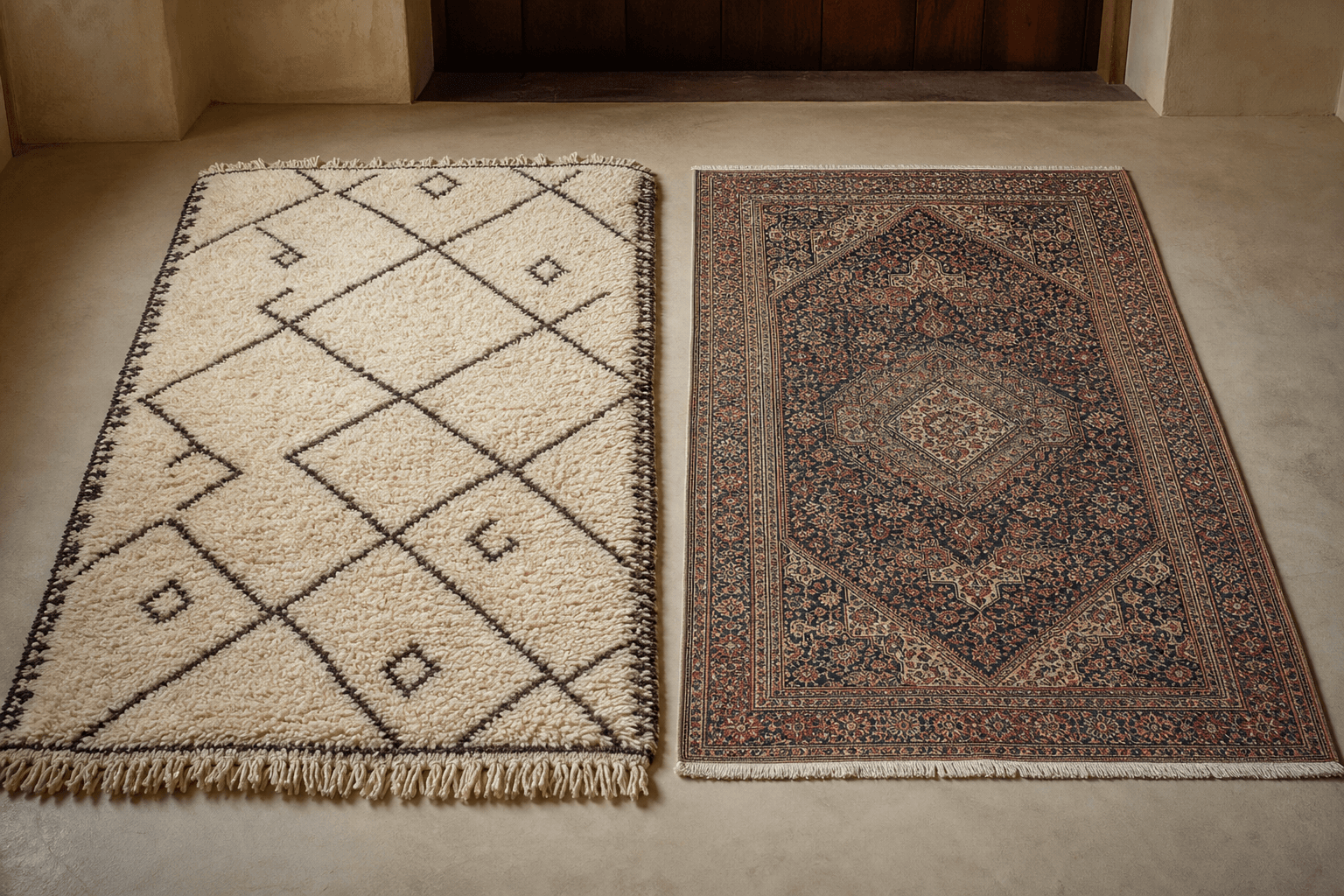
Atlas Mountain rugs are Moroccan textiles associated with varied weaving communities across the Middle Atlas, High Atlas, Anti-Atlas, and adjacent regions. They are not one pattern, color, pile, or universal symbolic code. Wool, climate, household use, trade, local history, and individual makers all shape the object. Reliable origin begins with documented geography and construction, not a familiar diamond motif.
A careful definition
Atlas is a geography before it is an aesthetic.
Use “Atlas rug” when the object’s Moroccan origin and regional relationship are documented. Use “Atlas-inspired” or “Moroccan style” when describing only a contemporary visual influence. Specificity protects both the buyer and the history.01 · Geography
Which Atlas Mountains are we talking about?
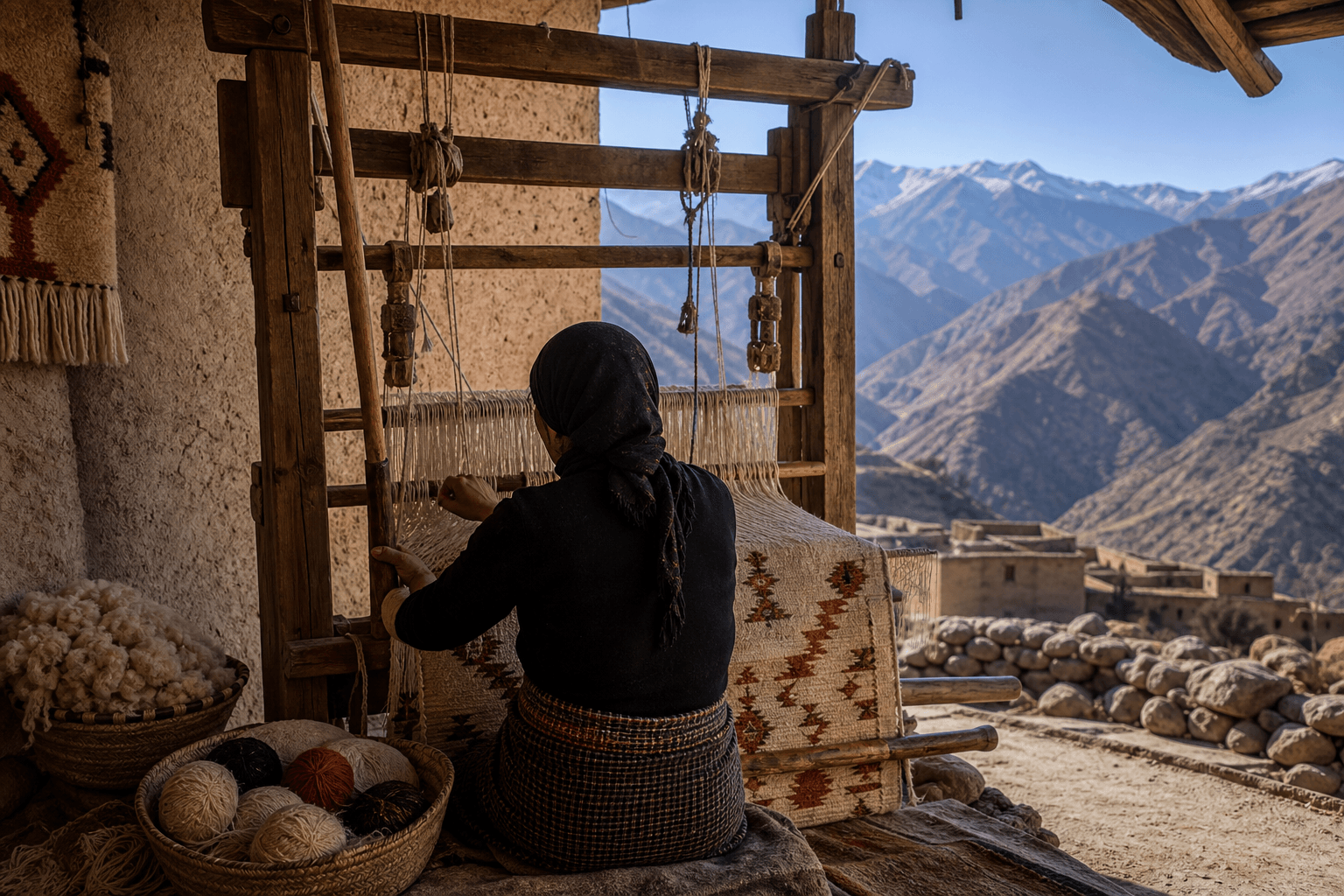
Morocco’s Atlas system spans distinct elevations, climates, towns, villages, and trade routes. “Middle Atlas” and “High Atlas” are not interchangeable production labels, and weaving also occurs beyond a narrow mountain boundary. Historic catalogues reflect this diversity: the Smithsonian Libraries record for the early twentieth-century Corpus des tapis marocains lists separate volumes for Rabat, Middle Atlas, High Atlas, and other rugs.
Geography shapes available fiber, household needs, market access, and the movement of motifs and materials, but it does not freeze design. Rugs travel, makers innovate, workshops respond to buyers, and regional terms can be simplified by later dealers. A precise seller should explain the basis for an attribution rather than presenting geography as self-evident from appearance.
Urban Moroccan carpets also belong to the larger history. The Met’s nineteenth-century Rabat carpet is wool with symmetrically knotted pile and an elongated format adapted to local architecture. Its dense urban design reminds us that Moroccan rug history includes more than the spare high-pile cream-and-black image dominant in contemporary interiors.
02 · People & language
Amazigh, Berber, tribal: which words should you use?
Amazigh is widely used as the self-identifying term for Indigenous peoples of North Africa; Imazighen is the plural. “Berber” remains common in older scholarship, museum records, trade language, and search queries, but it can flatten many communities into one market category. Use the terminology preferred by a documented maker or community where possible, and explain older terms when they appear in sources.
“Tribal rug” should not be used as a decorative synonym for handmade. If a seller names a confederation, community, or village, ask how the attribution was established. Was the maker known? Did the rug come through a cooperative with records? Is the identification based on material and structure reviewed by a specialist, or on a pattern that appears across several markets?
The Smithsonian Folklife Festival’s Moroccan weaving program presented weavers and cooperative leaders from the Middle Atlas and southern high-desert regions, describing weaving as cultural expression, economic work, and a source of pride. That context is more useful than romantic language that makes the maker anonymous while turning the rug into a timeless artifact.
03 · Wool & making
How do material and structure create the surface?
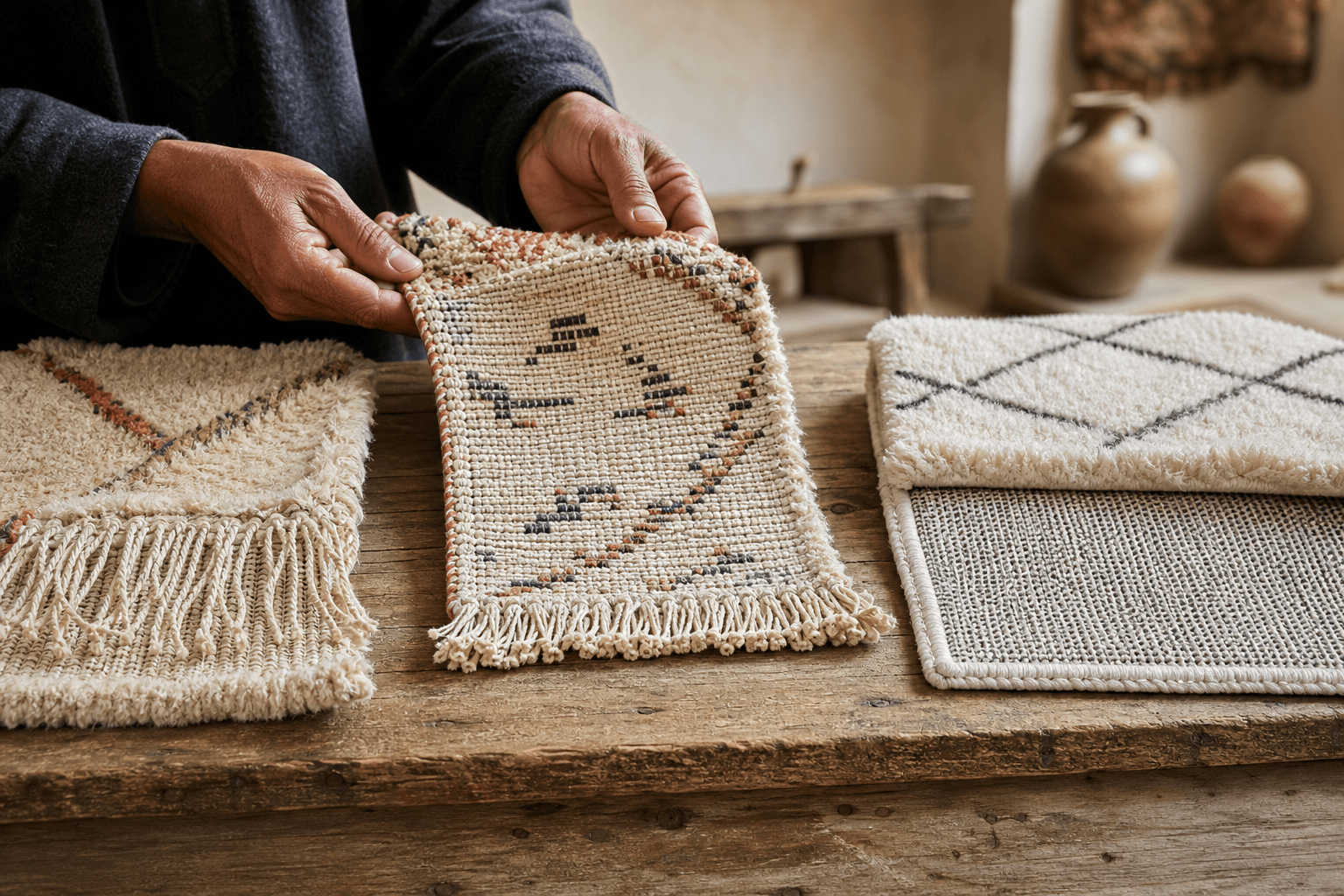
Wool is central to many Moroccan pile rugs because it can serve as pile and, in some structures, part of the foundation. Preparation, spinning, twist, dyeing, knotting or looping, weft packing, pile cutting, washing, and finishing all affect the final handle. “Natural wool” does not tell you whether the yarn is undyed, naturally dyed, synthetically dyed, handspun, mill-spun, or blended; ask for the level of detail actually known.
High pile creates warmth and visual depth but should not be treated as a universal marker of authenticity or quality. Moroccan traditions include flatweaves, lower pile, urban knotted carpets, mixed techniques, and textiles made for different household purposes. Judge structure within its tradition and intended use.
Turn the rug over. The reverse can reveal foundation, weft, knot rhythm, repair, and whether a backing hides the structure. Look at edges and fringe, not only the central motif. Our guide to rug construction explains how to distinguish knotted pile, tufted backing, and machine regularity without turning knot count into a universal grade.
04 · Motifs
Do Moroccan rug symbols have fixed meanings?
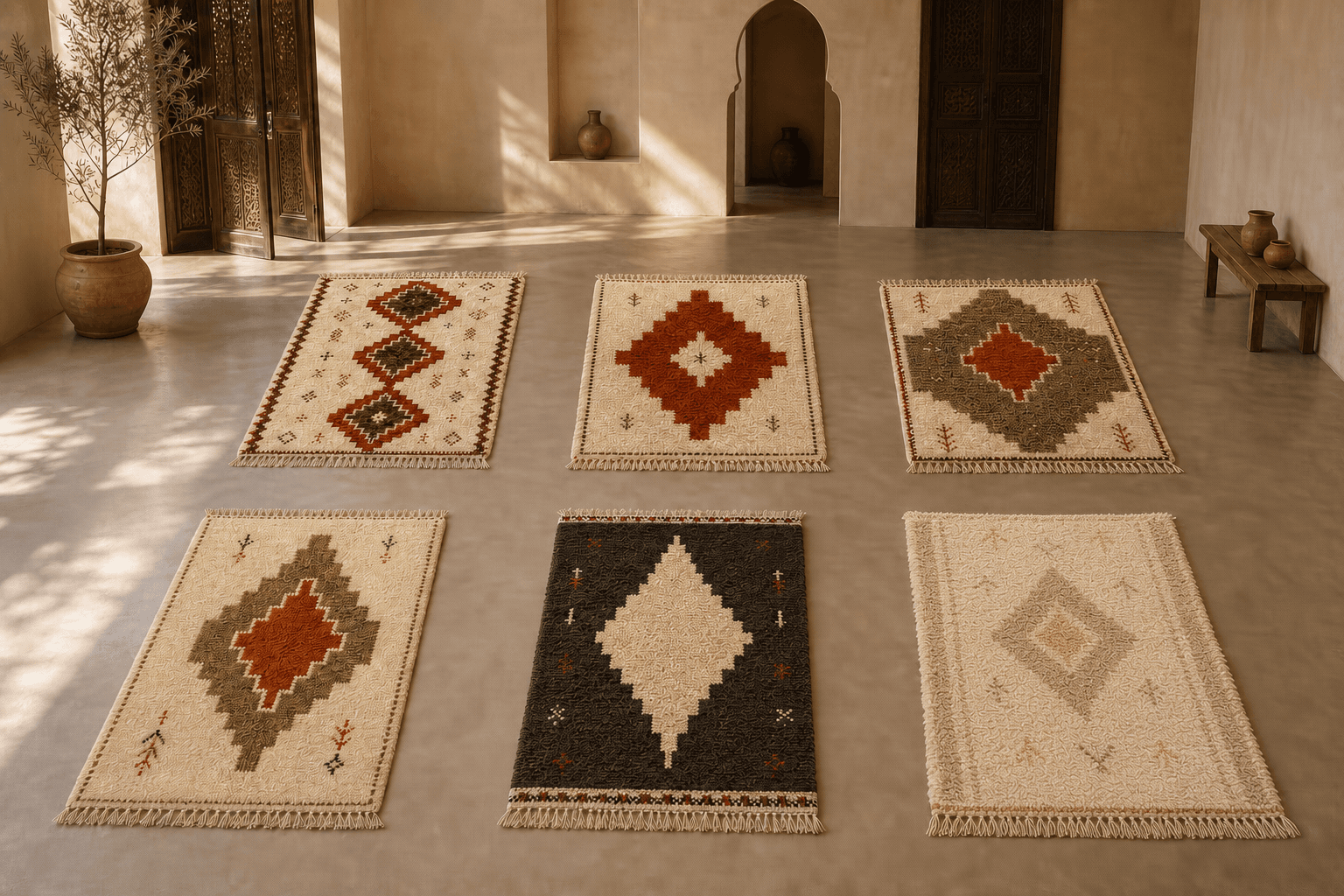
Some forms carry documented associations in particular communities, periods, or makers’ practices. A lozenge, hook, comb-like mark, tree, hand, eye, star, or stepped form may relate to protection, fertility, landscape, belief, personal memory, or simply the logic of weaving. The same shape can change meaning across contexts or be used because it balances the composition.
Be cautious with charts that assign one universal translation to every motif. Ask who recorded the meaning, when, where, and from whom. A maker’s own explanation is valuable experience but may not apply to every rug with a similar mark. Museum catalogue records and textile scholarship can document an object without claiming to decode every line.
Contemporary designers may also draw from mountain, memory, and geometry without reproducing a historic community pattern. LEOS Atlas I is presented as a contemporary Marrakech-rooted collection shaped by the presence of the Atlas. Its product stories are interpretations, while the concrete claims—made in Morocco, natural high-pile wool, dimensions, palette, edition, and certificate of origin—belong to the object record.
05 · Provenance
How can you verify the origin of a Moroccan rug?
- Separate origin from style.“Made in Morocco” and “Moroccan style” are different claims.
- Request the material and structure.Pile, foundation, backing, knot or weave, and dye information when known.
- Ask for the attribution basis.Maker, cooperative, workshop, region, purchase record, or specialist assessment.
- Document age and condition.New, vintage, antique, restored, repaired, washed, or altered.
- Keep the record.Invoice, certificate, photographs, dimensions, care, and seller communication should remain with the rug.
Provenance is a chain of evidence, not decorative confidence. A seller may honestly know only the country, approximate period, and construction. That limited truth is better than an elaborate village or symbolic story unsupported by records. Continue with the origin and quality questions before purchase.
06 · Age & market
How do new, vintage, and antique Atlas rugs differ?
New describes recent production, but it does not tell you whether the design is traditional, contemporary, cooperative-made, workshop-made, or created for export. Ask for the maker relationship, material, technique, design authorship, finishing, and country or regional record. A new rug can participate in a living tradition without pretending to be old.
Vintage is a market term without one universal age threshold. It should be paired with an estimated period and the basis for that estimate. Wear, fading, oxidation, repair, and softened pile can support an age assessment, but deliberate distressing and reused wool complicate visual judgment. Request condition photographs under neutral light and disclose uncertainty rather than converting an estimate into a precise year.
Antique usually implies greater age and may trigger stronger expectations around provenance, condition, conservation, appraisal, and export rules. A specialist should examine foundation, edge, pile loss, dye, repair, reduction, re-fringing, staining, moth activity, and whether previous treatments changed the object. Age can increase historical interest while decreasing suitability for heavy daily traffic.
Use condition language precisely
“Patina” may describe softened color and surface developed through time; it should not hide active damage. “Restored” should identify what was rebuilt, re-knotted, rebound, washed, or mounted. “As found” does not remove the seller’s responsibility to disclose odor, infestation, weakness, or repairs visible during inspection.
Keep contemporary interpretation separate
A new rug can draw on Atlas landscape, geometry, material, and memory without copying a documented historic object. State that relationship as inspiration. LEOS Atlas I product stories use mountain references as contemporary interpretation; the origin claim remains made in Morocco, supported by the object record and accompanying certificate.
Whether new or old, the strongest purchase combines an accurate description, an evidence trail proportionate to the claim, and a realistic plan for use. History adds meaning only when uncertainty and condition remain visible.
If cultural attribution materially affects price, seek an independent textile specialist rather than relying only on the seller. An assessment may still use cautious language, but it can distinguish documented structure and condition from market convention. Preserve that written opinion with the rug and update it when later scholarship or new provenance becomes available.
Digital records should include full-front and reverse photographs, edge and fringe details, measurements, seller identity, date of acquisition, and any spoken attribution written down in the seller’s own words. Store copies outside a marketplace account that may later disappear. Provenance becomes useful when it can remain attached to the object across owners and decades.
The origin principle