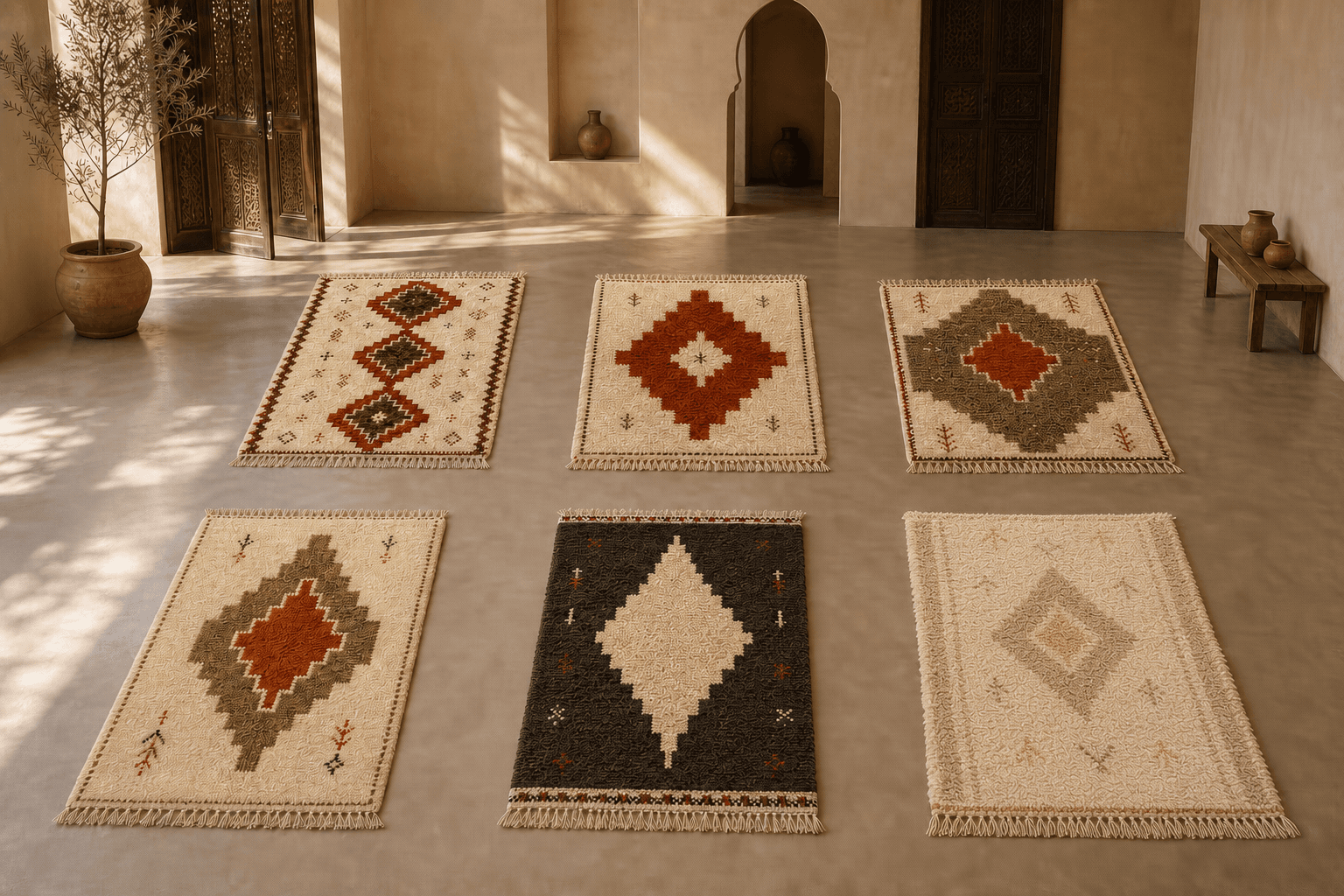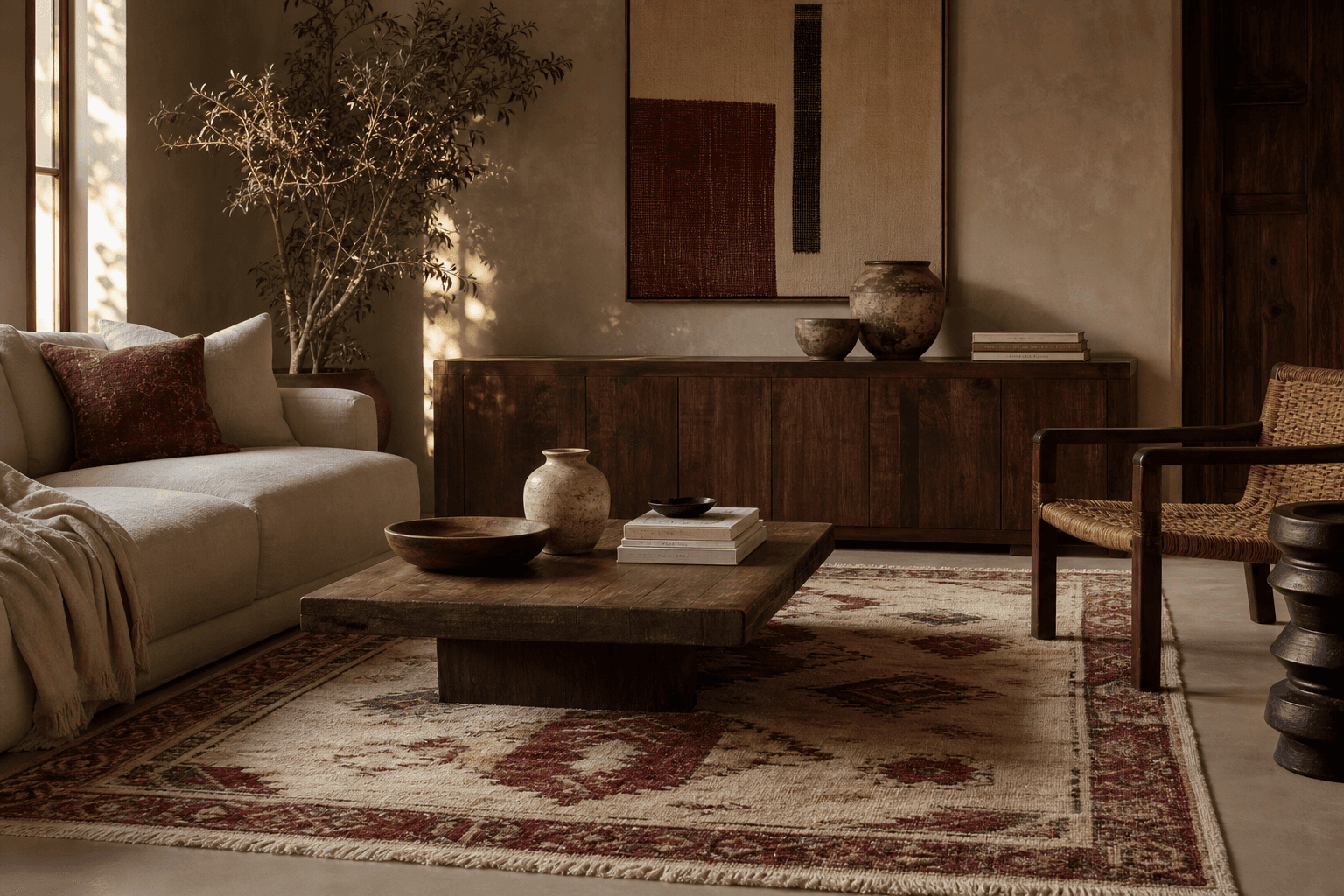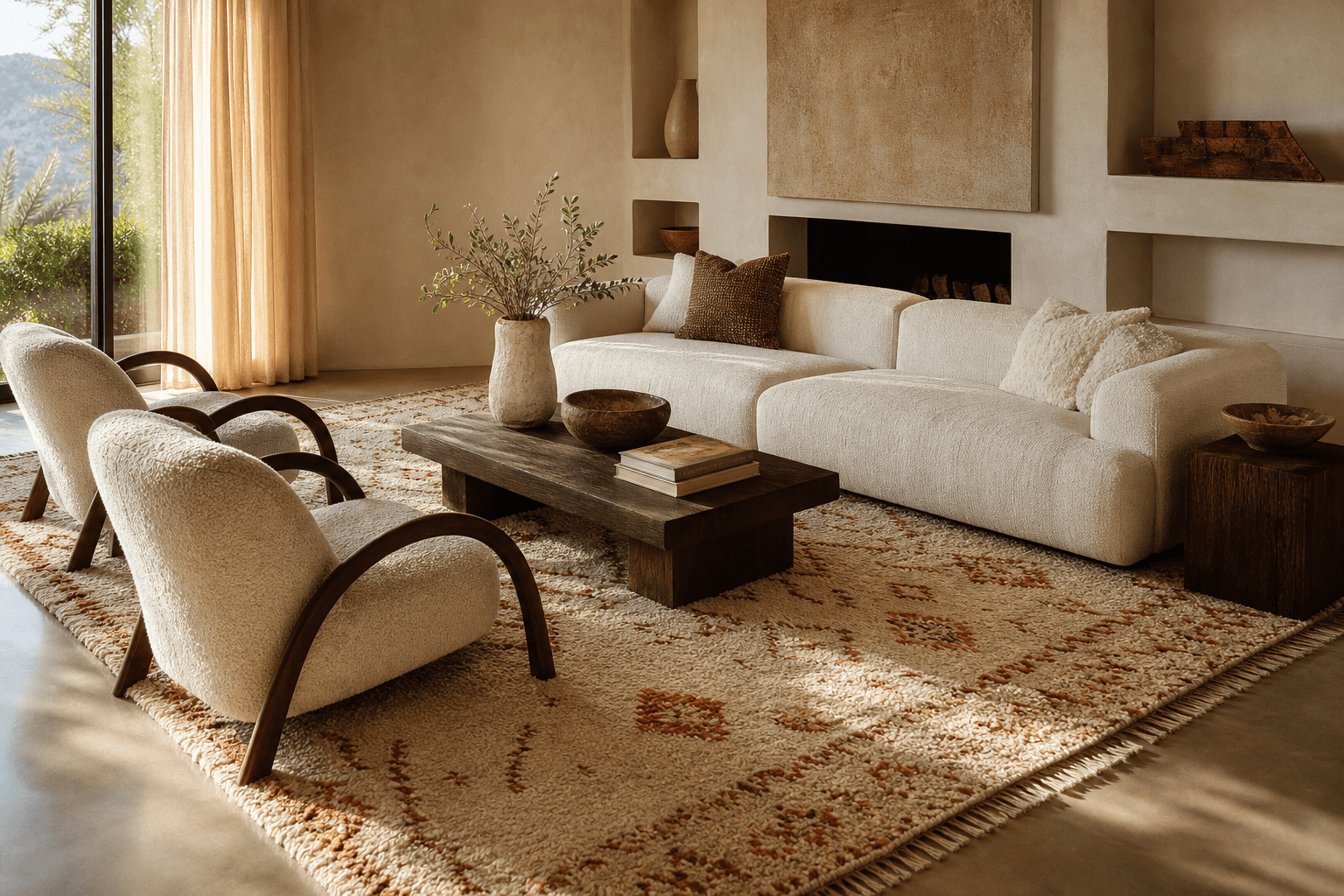
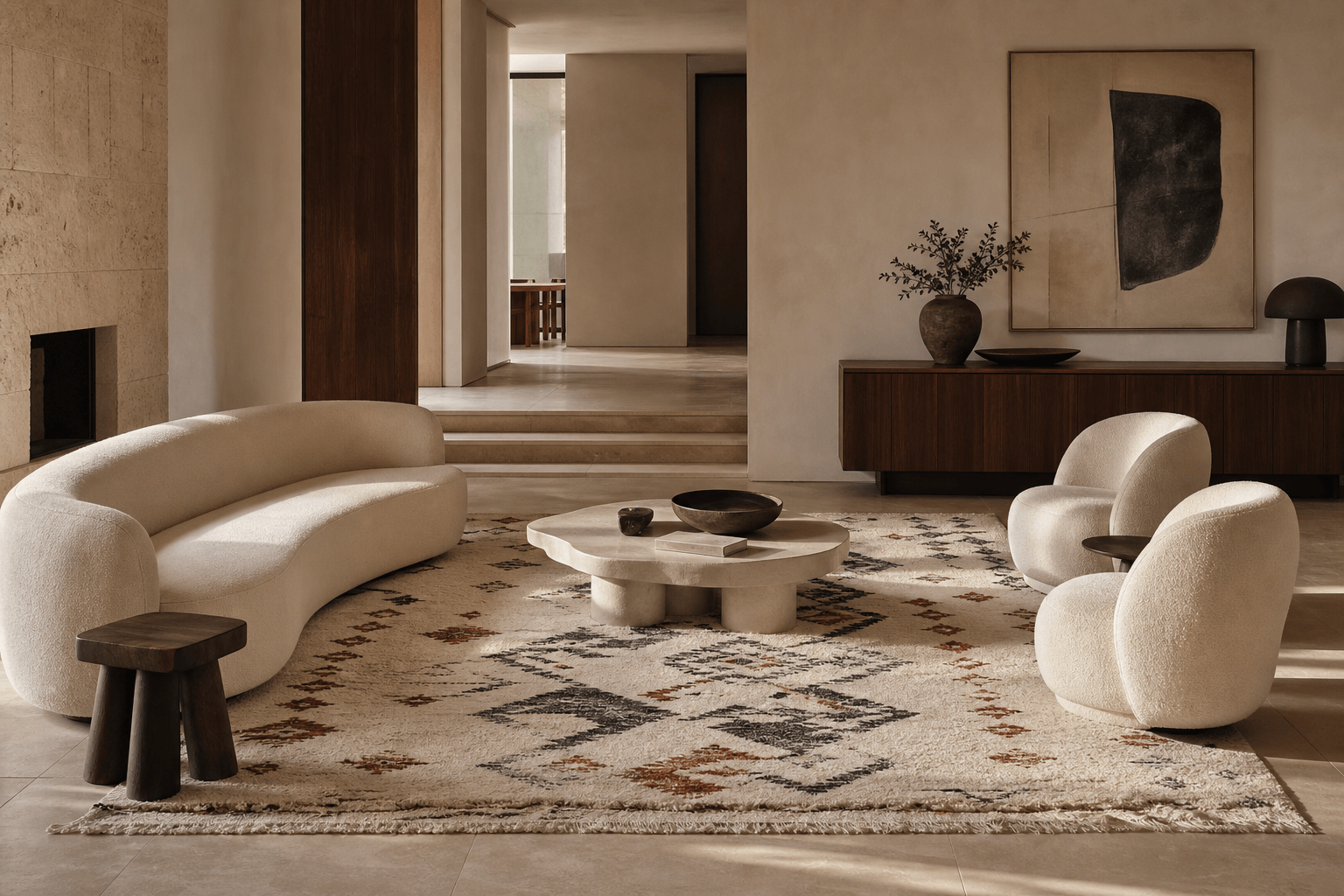
A Moroccan rug suits a modern interior when its scale, pile, contrast, and palette support the architecture instead of turning the room into a theme. Begin with the room’s dominant materials and visual weight. Then choose whether the rug should recede, warm the space, draw a clear center, or provide the strongest dark plane.
The modern-room formula
Match material; contrast the room’s weakness.
Use wool to soften hard stone and plaster, a pale field to preserve visual quiet, an earthen medallion to warm neutral furniture, or a dark field to ground a room that otherwise floats. Avoid matching every color.01 · Read the room
Choose the rug after naming the architecture
List the room’s fixed elements: floor, wall color, timber, metal, fireplace, glazing, and ceiling height. Then list the large movable forms: sofa, dining table, bed, art, and lighting. A rug should solve a material or compositional need among those elements. Thick wool can soften travertine and glass; a long medallion can connect a deep sofa with two chairs; charcoal can stabilize pale curved furniture.
Modern does not require neutral. It requires hierarchy. A saffron or garnet center can be the room’s one saturated field when upholstery and walls remain restrained. A complex rug can live with expressive art if their scales differ and the room includes enough quiet surface between them. What makes a room feel confused is not color itself but several elements competing at the same intensity.
Measure before styling. The rug must connect the furniture and respect doors, circulation, and chair movement. Tape the exact outline rather than selecting “5 × 8” as an abstract category. Use the room-by-room guide, then return to palette and pile once the footprint is correct.
02 · Interior language
Which kind of Moroccan rug fits your modern style?
| Interior | Rug direction | Atlas I starting point |
|---|---|---|
| Minimal | Tonal field, visible wool, low color contrast | Quiet Dune |
| Warm modern | Ivory ground with rust, saffron, or taupe center | Saffron Gate |
| Brutalist | Strong mass, dark or stone palette, simple geometry | Night Atlas |
| Contemporary classic | Centered composition with controlled border or rhythm | Toubkal Ember |
| Color-forward | One saturated rug color echoed sparingly elsewhere | Burnt Ridge |
These pairings describe visual behavior, not rules. Quiet Dune can calm a maximal room; Night Atlas can make a traditional library feel newly graphic. Use definitive product images and exact dimensions from the Atlas I comparison guide rather than choosing from category names alone.
03 · Contrast
How much contrast does the room need?
Photograph the room in grayscale. If furniture, floor, and walls collapse into one middle tone, the space may need a dark field, a clear center, or a stronger edge. If architecture already has black steel, dark timber, bold art, and deep shadow, a pale rug can create relief. Tonal contrast is often more important than exact hue.
Next, identify color temperature. Warm plaster, walnut, aged brass, and cream upholstery accept rust, saffron, taupe, and umber naturally. Cooler concrete, stainless steel, and blue-gray stone can be warmed deliberately by those colors or held in tension with charcoal and flax. Do not search for a perfect floor match; slight separation helps the rug remain visible as material.
Repeat one minor color once
Pull a small garnet, clay, or blush note into one cushion, artwork, book spine, or ceramic. Repeating the rug’s dominant color across several objects can feel coordinated too literally. One echo creates connection; the rest of the room can rely on texture—linen, wood grain, plaster, stone, and wool—to build depth.
04 · Pile & use
Modern appearance still has to support daily life
High pile gives hard-edged rooms softness and changes dramatically under side light. It also needs door clearance, controlled vacuuming, and thoughtful placement beneath chairs. A dining room with frequently moved chairs may suit lower pile better; a bedroom, salon, or reading room can make full use of plush wool. Match material to movement before using it as visual contrast.
A pad should stabilize the rug, protect the floor, and reduce abrasion. Choose one compatible with the floor finish and slightly smaller than the rug. Rotate the piece when one side receives more traffic or direct sun. Read the wool rug care guide for vacuuming, spills, pets, heated floors, and professional washing.
Modern rooms often have large glazing. Review the rug at different times of day before committing to its visual role. Pale high pile may reveal a pattern only in raking light; charcoal can become softer and more dimensional near a window. The product’s studio image tells only half the story, which is why each LEOS piece includes several room studies.
05 · Edit
Five mistakes that make the room feel less modern
- Choosing too small.A floating rug fragments furniture regardless of how restrained the palette is.
- Building a theme.Pair the rug with the architecture, not a collection of geographic clichés.
- Matching every color.Repeat one accent and let natural materials carry the rest.
- Ignoring pile.Door swing, chair movement, pets, and cleaning must suit the surface.
- Using several focal points.Decide whether rug, art, view, or furniture leads.
Once edited, a Moroccan rug can make a modern room feel less anonymous. Its hand, wool, and changing surface provide evidence of time without requiring ornamental excess. The goal is not contrast for its own sake; it is a room where material and geometry feel inevitable together.
06 · Room examples
Translate the principles into real modern rooms
Pale plaster, cream boucle, and travertine
This room already has softness of color but may lack a clear base. Quiet Dune preserves the tonal range and adds changing pile; Oued Stone introduces a contained garnet center; Night Atlas creates the strongest editorial contrast. Choose according to whether the missing quality is texture, focus, or weight. Do not add more cream simply because it appears safe.
Concrete, black steel, and low leather seating
Hard surfaces benefit from wool, but the rug need not repeat the industrial palette. Burnt Ridge or Toubkal Ember can introduce earth and human irregularity, keeping the room from becoming cold. If art already supplies saturated color, use a stone or parchment field and let pile provide the contrast.
Walnut joinery and contemporary classic furniture
Warm timber welcomes saffron, rust, umber, and garnet, but control the number of brown-adjacent tones. A rug with a cream field separates dark furniture from the floor. Repeat one ember or garnet note at eye level and use unpatterned linen curtains to keep the composition clear.
A white apartment with large glazing
Strong daylight can flatten pale textiles at noon and reveal them beautifully in morning or evening side light. Test a tonal rug at several times before assuming it disappears. A charcoal field may feel dramatic during the day and quietly reflective at night. Use window treatment and rotation to manage direct sun on wool.
An open plan joining living and dining
Give each zone one material identity. A plush Moroccan rug can anchor the living area while the dining zone uses bare stone or a lower-pile flatweave. Repeat one background tone, not the exact pattern. Maintain clear floor between rugs so they read as distinct rooms without walls.
Modernity comes from disciplined relationships rather than a narrow style catalogue. A Moroccan rug can be graphic, neutral, saturated, historic, or contemporary; the room becomes coherent when size, tonal contrast, material, and hierarchy are decided in that order.
Complete the room with a sample test when possible. Place wool yarn, a fabric swatch, or a printed crop of the rug beside the actual floor, sofa, and timber in daylight and evening light. Screens shift warm neutrals. A small physical comparison cannot predict the whole rug, but it can reveal temperature conflicts before the full object arrives.
Keep future flexibility. Choose a rug that still works if one chair, artwork, or wall color changes. Modern interiors feel durable when their largest objects share material and proportion rather than depending on an exact set of accessories.
Photograph the finished room in daylight and evening light, then edit any accessory that competes with the rug’s intended role.
Before delivery, clear the intended zone and photograph the bare room. When the rug arrives, allow it to settle, then repeat the same camera positions. Compare furniture connection, color temperature, glare, and circulation before removing tags or return packaging. This disciplined installation check is more useful than judging the object while it is still tightly rolled or surrounded by shipping materials.
The modern-room principle