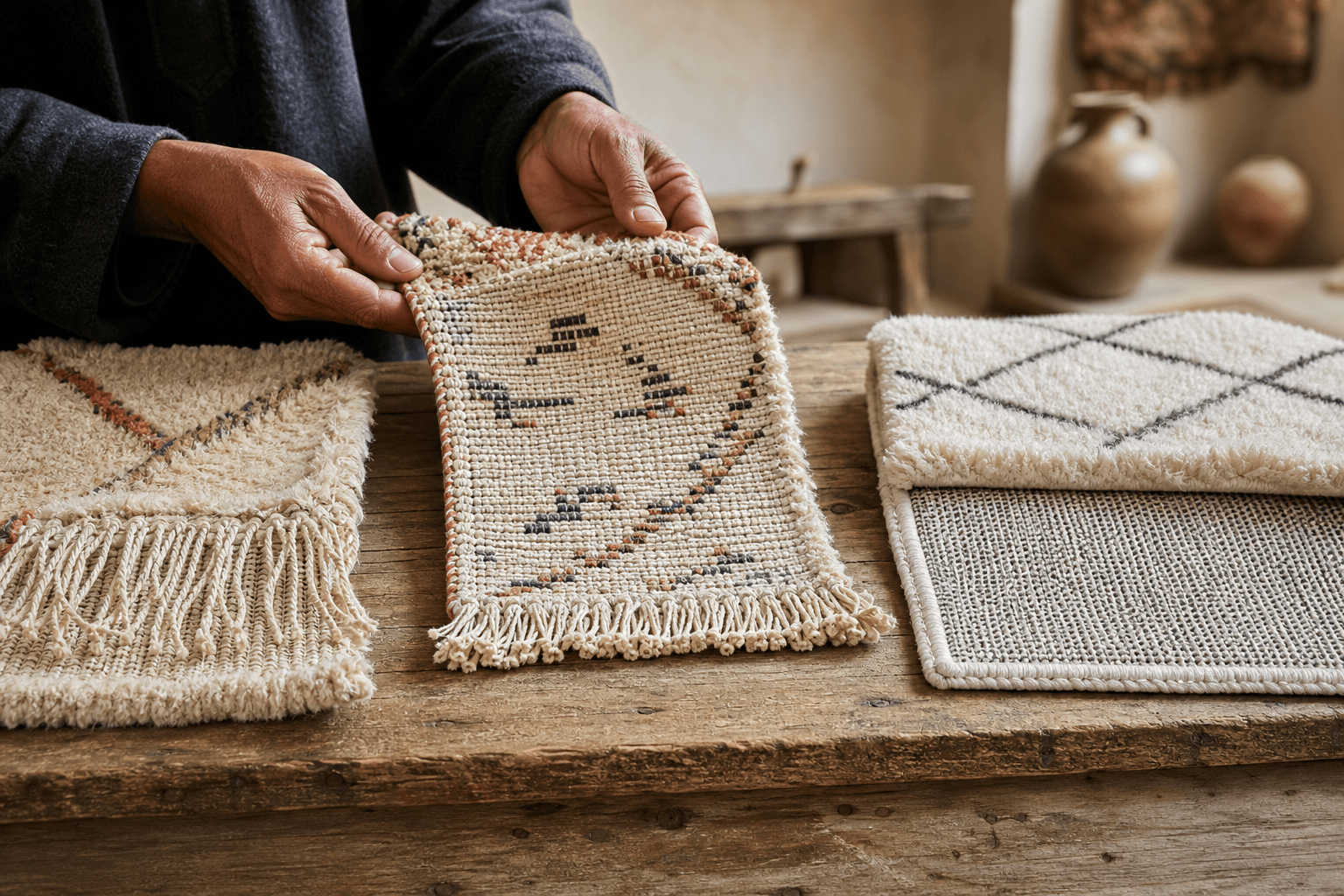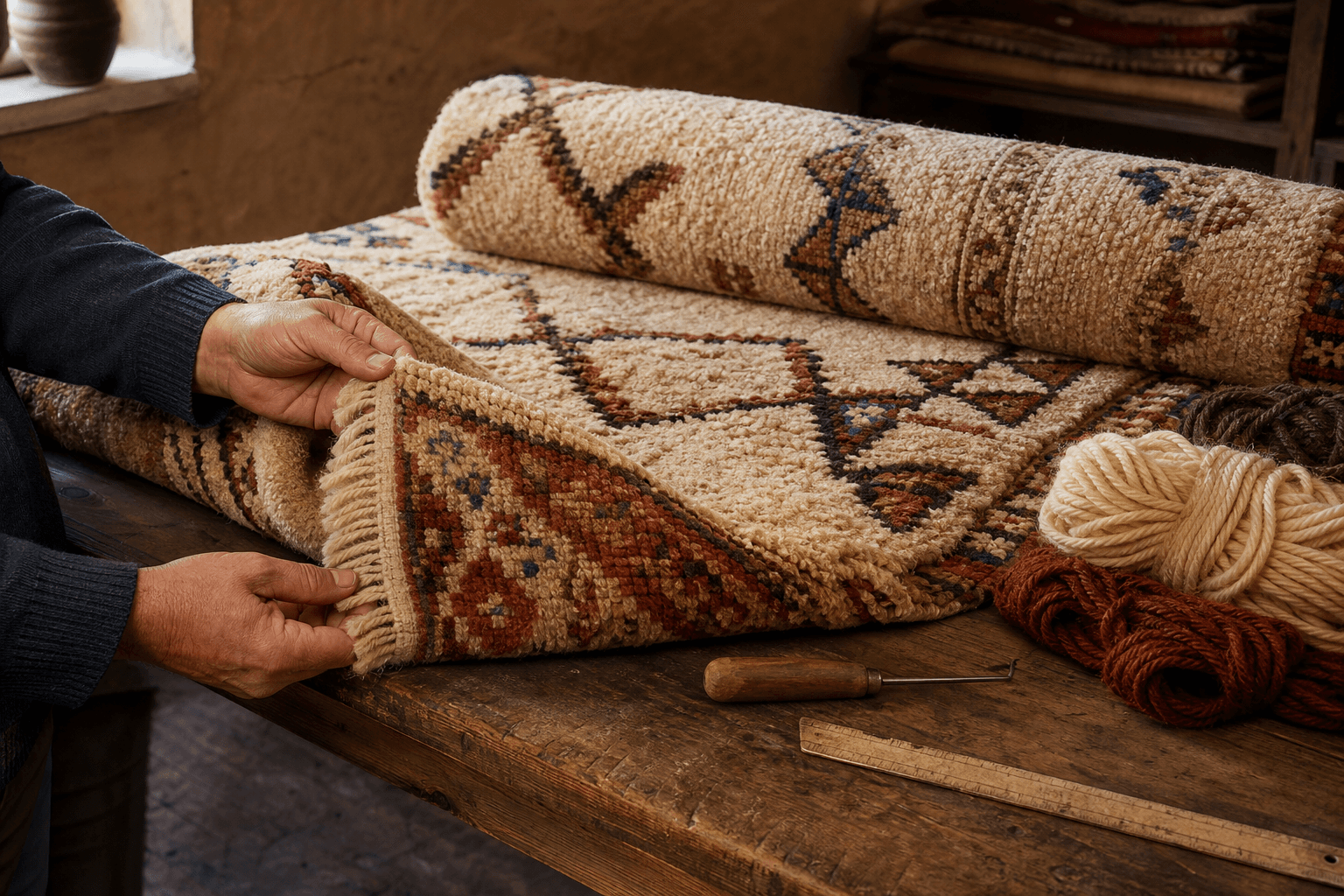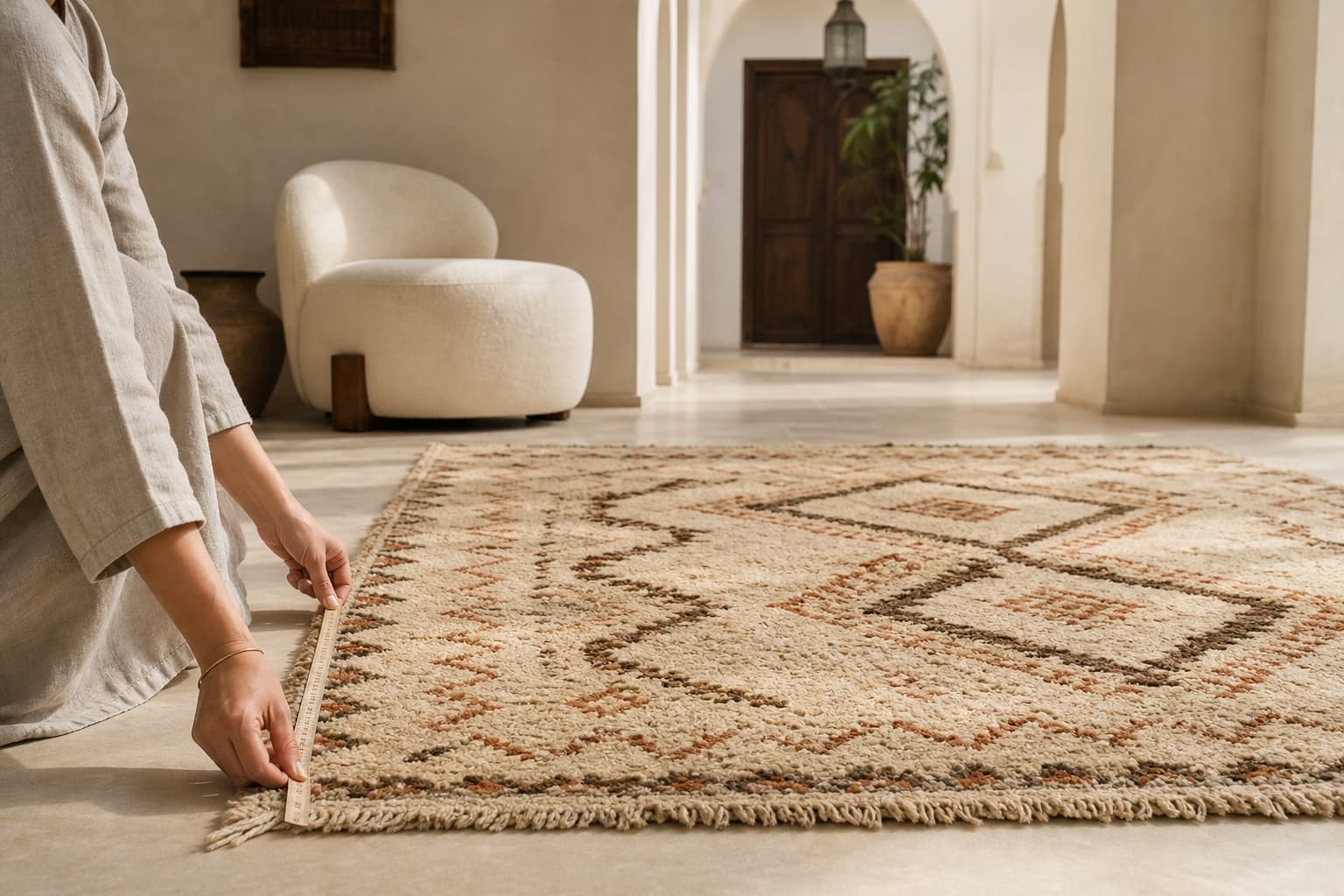
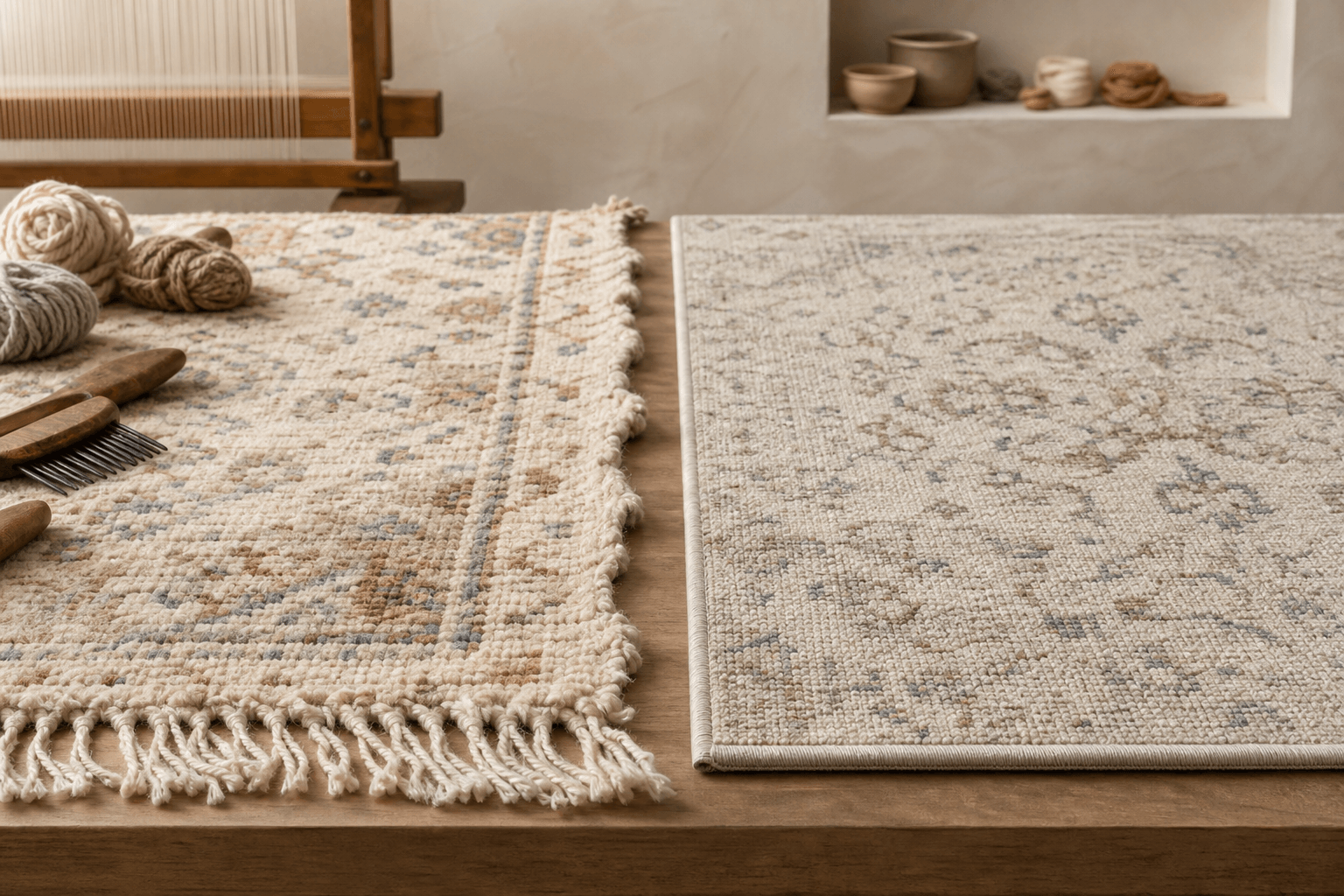
Artisan and mass-produced rugs differ most in how decisions enter the object. An artisan rug is shaped through hand-controlled material, tension, color, pattern, and finishing; a mass-produced rug is engineered for repeatability, speed, consistent sizing, and a target price. Neither label guarantees quality. Compare the actual fiber, structure, backing, finishing, service, and household fit.
The fair comparison
Measure difference before assigning value.
An artisan rug may offer one-of-one variation, documented making, and specialist repair. A mass-produced rug may offer exact repeats, predictable performance, and lower replacement cost. The better choice is the one honestly specified for the way you live.01 · Definitions
What do artisan and mass-produced actually mean?
“Artisan” should describe a real production relationship, not a distressed finish or a photograph of hands. Ask which stages are done by hand, where the work occurs, how material is chosen, whether the design is one of one or repeated, and who holds responsibility for finishing and quality control. Hand-knotted, handwoven, and hand-tufted are different structures; an artisan may make any of them.
“Mass-produced” means the product is designed for repeat manufacturing. That may involve powered looms, printed surfaces, tufting lines, automated cutting, and standardized binding. Production can use wool, cotton, polypropylene, polyester, nylon, viscose, or blends. Some factory rugs are technically sophisticated and durable; others are designed primarily around low initial price. Read the specification, not the category.
Luxury branding does not settle the question. A costly rug can still use a tufted adhesive-backed structure, while a modestly priced flatweave can be honest, useful, and repairable. Begin with the construction comparison, then compare sellers on the clarity of their product record and aftercare.
02 · Differences
What changes from workshop to production line?
| Decision | Artisan production may offer | Mass production may offer |
|---|---|---|
| Design | One-of-one or small-run variation | Exact repeat and broad size range |
| Material record | Specific local or workshop knowledge | Standardized technical specification |
| Surface | Human shifts in line, tone, tension, and pile | Highly consistent pattern and finish |
| Availability | The exact object or a lead time | Stock replacement and matched multiples |
| Repair | Local structural repair may be possible | Replacement may cost less than specialist repair |
| Service | Direct knowledge can be excellent but varies by seller | Formal warranties and logistics can be scalable |
Repeatability can be a feature. Hotels, paired rooms, commercial spaces, and households needing an exact replacement may value a reproducible design. Variation can also be a feature: a one-of-one rug gives the room a specific object rather than a standardized surface. Decide which quality serves the project instead of treating one as morally superior by default.
03 · Quality
How do you compare quality without touching the rug?
Require a full-front image, reverse, pile detail, edge, fringe, backing, and room view. Check whether the pattern appears in the reverse structure or only on the face. Read fiber percentages and identify the foundation and backing, not just the headline pile. Look for straight, secure edges, coherent tension, accurate dimensions, and care instructions suited to the actual material.
Variation should make sense across an artisan object. A shifted line, tonal passage, or slightly irregular edge can record handwork; holes, detached binding, loose foundation, powdering adhesive, or unreported stains are condition issues. Factory consistency also deserves inspection: look for edge curling, thin spots, visible backing through the pile, poorly aligned printing, odor, and whether the non-slip treatment is compatible with your floor.
Ask what happens after purchase. Can you obtain a replacement or matching size? Who handles a defect? Is specialist repair realistic? What is the return window after the rug is unrolled? Is freight insured? A beautiful product with vague service can be a worse purchase than a simpler rug supported by precise terms. Use the complete pre-purchase guide for the final checks.
04 · Claims
What about labor, sustainability, and authenticity?
Do not infer ethical labor from “handmade,” nor harmful labor from “factory-made.” Ask for evidence: supplier relationships, workshop or factory location, traceable materials, certifications when relevant, and a clear explanation of who performs the work. Vague social-impact language should not substitute for names, policies, or verifiable programs.
Environmental comparison also requires a full lifecycle. Natural wool is renewable but still carries farming, washing, dyeing, transport, and cleaning impacts. Synthetic fibers use fossil feedstocks and can shed microfibers, while long service life and efficient production may reduce replacement frequency. Adhesive, backing, repair, recyclability, packaging, and shipping all matter. Avoid one-material slogans.
Authenticity should mean accurate description. A machine-made “Moroccan style” rug can be honestly labeled and aesthetically successful. It becomes misleading when appearance is used to imply Moroccan origin or hand-knotted construction. LEOS describes its Atlas I pieces as made in Morocco from natural high-pile wool and pairs each object with a certificate of origin; the evidence should travel with the sale.
05 · Decision
When does each production model make sense?
- Choose artisan-made when you want a specific object, value visible hand decisions, accept variation, and can support specialist care.
- Choose mass-produced when exact sizing, matched repeats, performance fibers, lower initial cost, or quick replacement leads the brief.
- Choose neither yet when material, origin, backing, care, or return terms remain unclear.
Compare total suitability, not only price. A lower-cost rug that fits the room, survives the household, and receives proper care can be responsible. A handmade rug kept and repaired for years can also justify a higher initial cost. The wrong purchase in either category is the one sold through assumptions you never verified.
06 · Total cost
Compare the life of the purchase, not only the receipt
Initial price is easy to compare because it appears in one number. Ownership is more complex. Add the pad, insured delivery, duties, routine products approved for the fiber, professional cleaning, possible repair, and the cost or difficulty of replacement. Then consider how long you realistically expect the rug to remain in the same household—not an advertised lifespan.
An artisan rug can concentrate cost at purchase and later specialist care. Its value may include a specific object, maker relationship, documented origin, repairable structure, and emotional continuity. A mass-produced rug can lower entry cost and make an exact replacement easier, but a discontinued pattern or damaged backing may end the useful life sooner than expected. Neither outcome is guaranteed.
Account for project risk
Designers furnishing several rooms may need matched sizes, color consistency, short lead times, and formal commercial warranties. Those needs can outweigh one-of-one variation. A private room built around one object may value the opposite. Write the acceptable variation, delivery deadline, maintenance capability, and replacement strategy into the brief before requesting quotes.
Account for care access
A hand-knotted wool rug is a poor long-term plan if no qualified cleaner can service the region or the owner cannot move and insure it safely. A washable or replaceable rug may be rational in a remote, rental, temporary, or high-turnover setting. Conversely, easy access to a respected rug-care specialist makes repair and periodic washing a realistic part of ownership.
Account for attachment
Replacement cost is not only financial. A one-of-one rug may accumulate memory and become difficult to replace even when repair costs exceed the price of a new mass product. That emotional value is legitimate when named honestly. It should not, however, be assumed for every handmade object or used to excuse poor documentation.
The clearest comparison states what each option is designed to optimize. Choose the production model whose strengths align with the project, then demand precise material, structure, service, and care information within that model.
When comparing online prices, normalize the specification. Record finished dimensions, pile fiber, foundation, backing, construction, country of origin, freight, duties, pad, warranty, return freight, and whether the exact object or a representative sample is shown. A simple worksheet exposes when two apparently similar rugs are selling different structures, services, or levels of certainty.
Keep the comparison after purchase. Attach the final specification, invoice, photographs, and care record to the rug’s file. If performance later differs from expectation, you can identify whether the cause was material, construction, household use, cleaning, or an inaccurate claim. Good records turn a subjective disappointment into a question that a seller or specialist can actually assess.
Record keeping is useful for every rug, because repeat production does not guarantee permanent availability or identical future batches.
The comparison rule