Style a Moroccan rug by deciding its role first: focal point, warm foundation, dark ground, or quiet texture. Repeat one minor color once, vary material rather than matching every object, and keep competing patterns at different scales. The rug should connect architecture and furniture without requiring the rest of the room to imitate it.
The styling rule
Echo once. Contrast texture. Edit pattern.
Pull one small rug color into a cushion, artwork, book, or ceramic; pair wool with linen, timber, plaster, stone, or metal; and allow only one dense pattern to lead within the same sightline.01 · Role
What job should the rug perform?
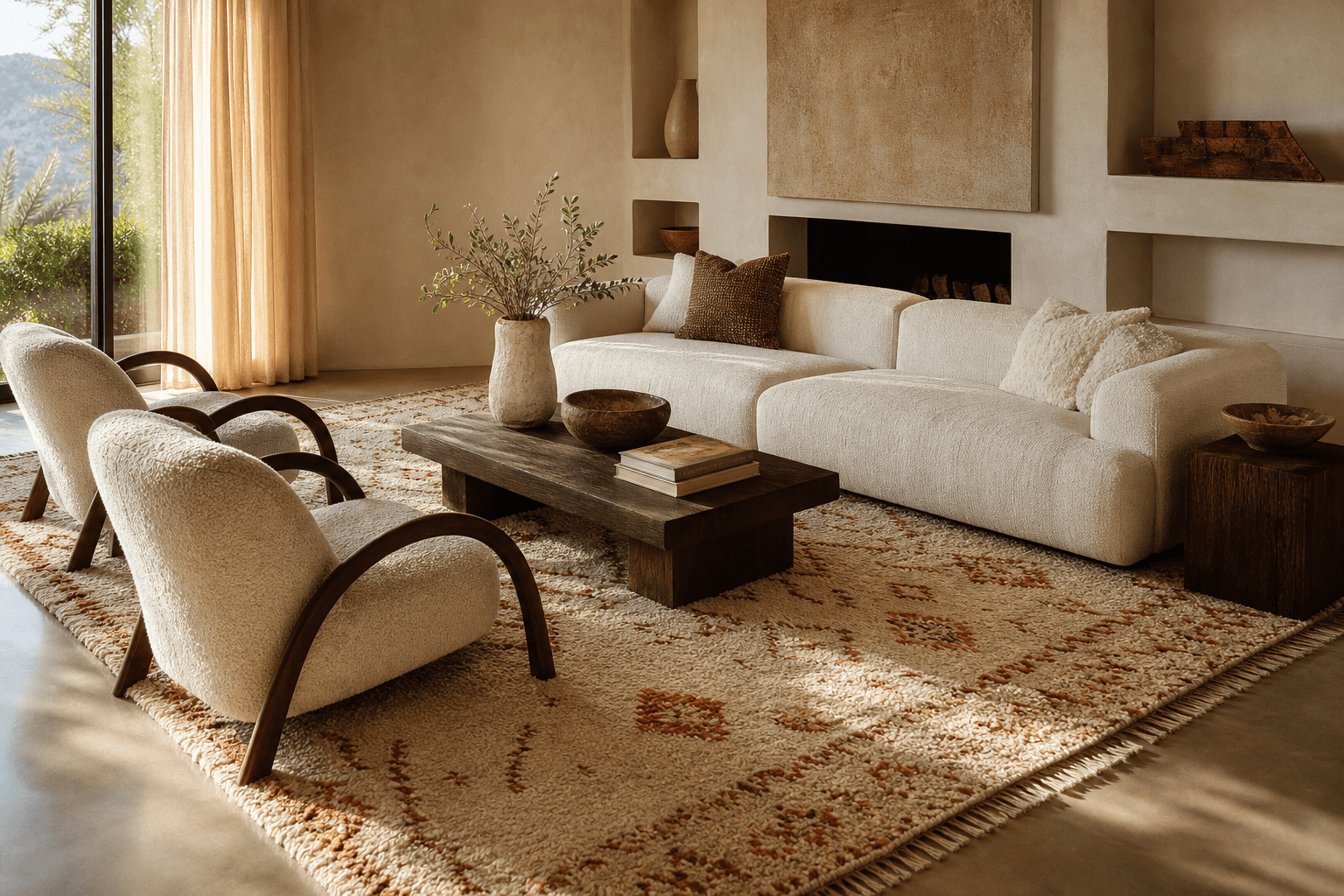
A focal rug carries the room’s strongest color, geometry, or tonal contrast. Keep the coffee table simple, give the central motif room to breathe, and let large upholstery remain quiet. A foundation rug connects furniture through material and scale without demanding first attention. Choose a tonal field or lower contrast when art, view, or furniture already leads.
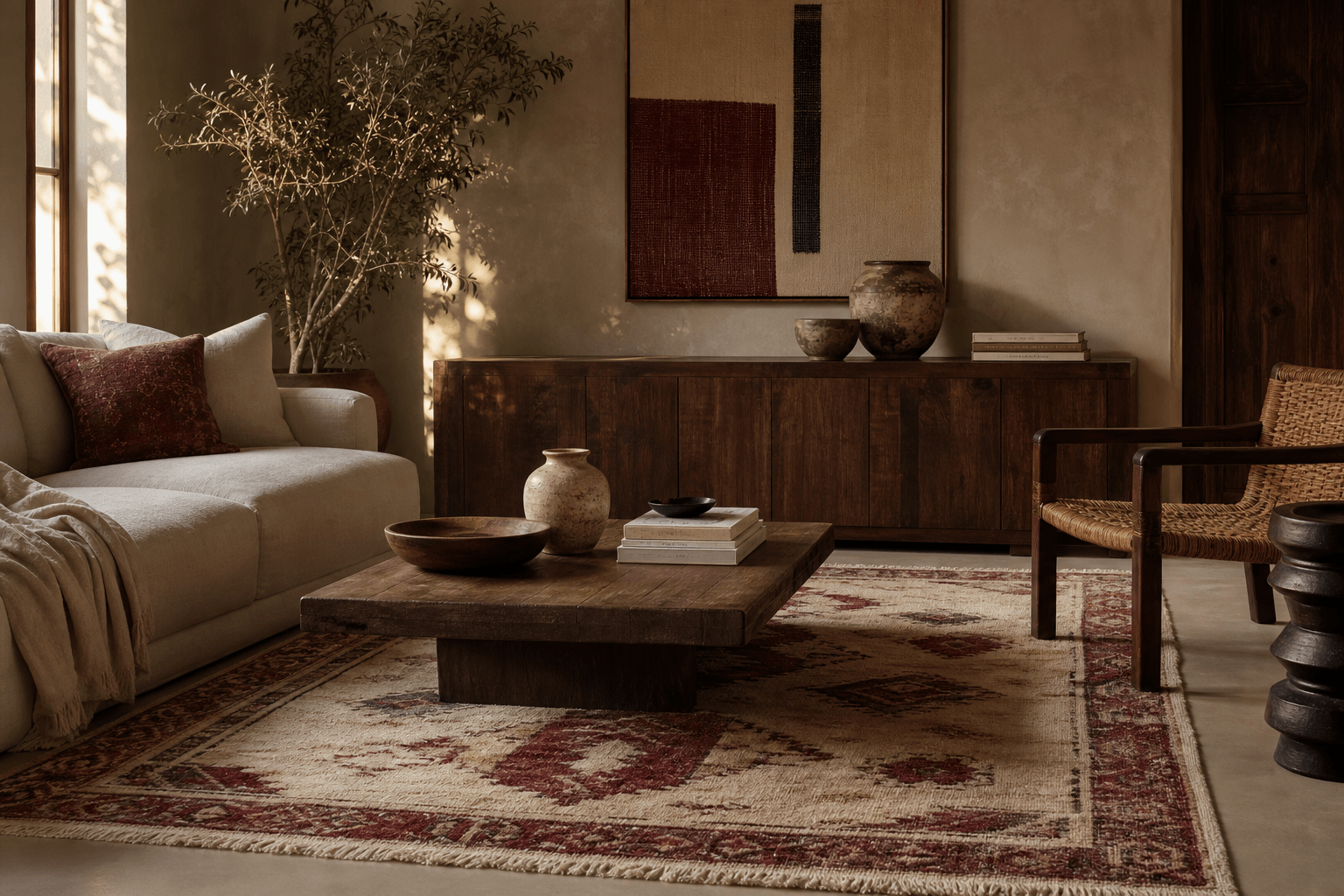
A dark-ground rug can stabilize pale seating and high light; a warm-centered rug can correct a room dominated by cool stone or gray fabric; a quiet ivory rug can soften architecture without reducing its clarity. Name the missing quality—weight, warmth, rhythm, softness, or focus—before shopping. “I need a Moroccan rug” is not yet a styling brief.
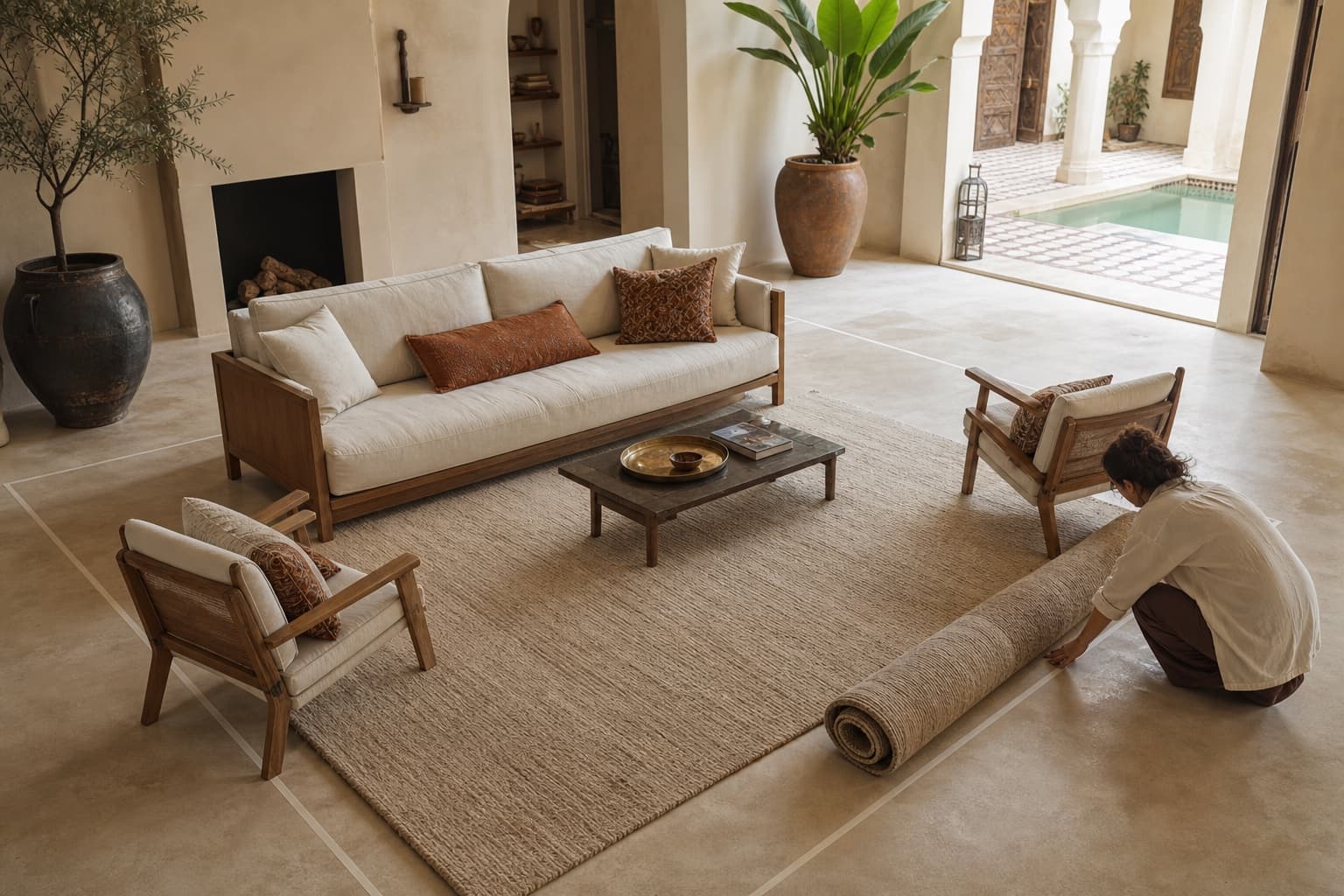
The footprint must already work. If furniture floats outside the rug, color styling will not repair the plan. Use the anchoring guide and the exact size guide before arranging accent colors.
02 · Color
How do you repeat color without overmatching?
Identify the rug’s field, dominant motif, and smallest accent. The field determines how much visual floor the room receives; the dominant motif establishes the main energy; the smallest accent is usually the best color to repeat. A rust mark echoed in one cushion or artwork can connect the room without turning every object rust.
Match temperature more often than exact hue. Warm ivory can sit with cream, oat, sand, and pale oak without being identical. Garnet can relate to oxblood, terracotta, and dark cherry through shared warmth. Charcoal can connect blackened steel and dark walnut while remaining softer than either. Slight variation makes the room feel collected rather than purchased as a set.
Use the 60–30–10 idea as a check, not a formula
Let the architecture and large upholstery hold most of the room, allow timber and rug to form a secondary material layer, and use the smallest saturated rug color sparingly. The percentages need not be literal. The principle simply prevents a compelling accent from multiplying until it loses its force.
03 · Texture
Which materials belong beside wool?
| Material | What it adds beside wool | Use with restraint |
|---|---|---|
| Linen | Dry, relaxed weave against plush pile | Avoid matching every textile in the same beige |
| Walnut or cedar | Dark linear grain and warmth | One or two strong timber families are enough |
| Plaster or limewash | Quiet mineral field that receives shadow | Let surface variation replace extra decoration |
| Stone or travertine | Cool weight beneath soft fiber | Check rug pad and floor compatibility |
| Aged brass or blackened metal | Small points of hard contrast | Use as punctuation, not a theme |
| Ceramic | Handmade irregularity at a smaller scale | Group by tone or form rather than scattering many pieces |
Texture becomes especially important in neutral rooms. If walls, sofa, curtains, and rug share similar hues, vary pile, weave, grain, sheen, and edge. A high-pile wool rug beside boucle, fuzzy cushions, shag throws, and heavy curtains can become visually dense even in cream. Give the wool one smoother neighbor—linen, leather, polished wood, or stone.
04 · Pattern
How do you mix a patterned rug with art and upholstery?
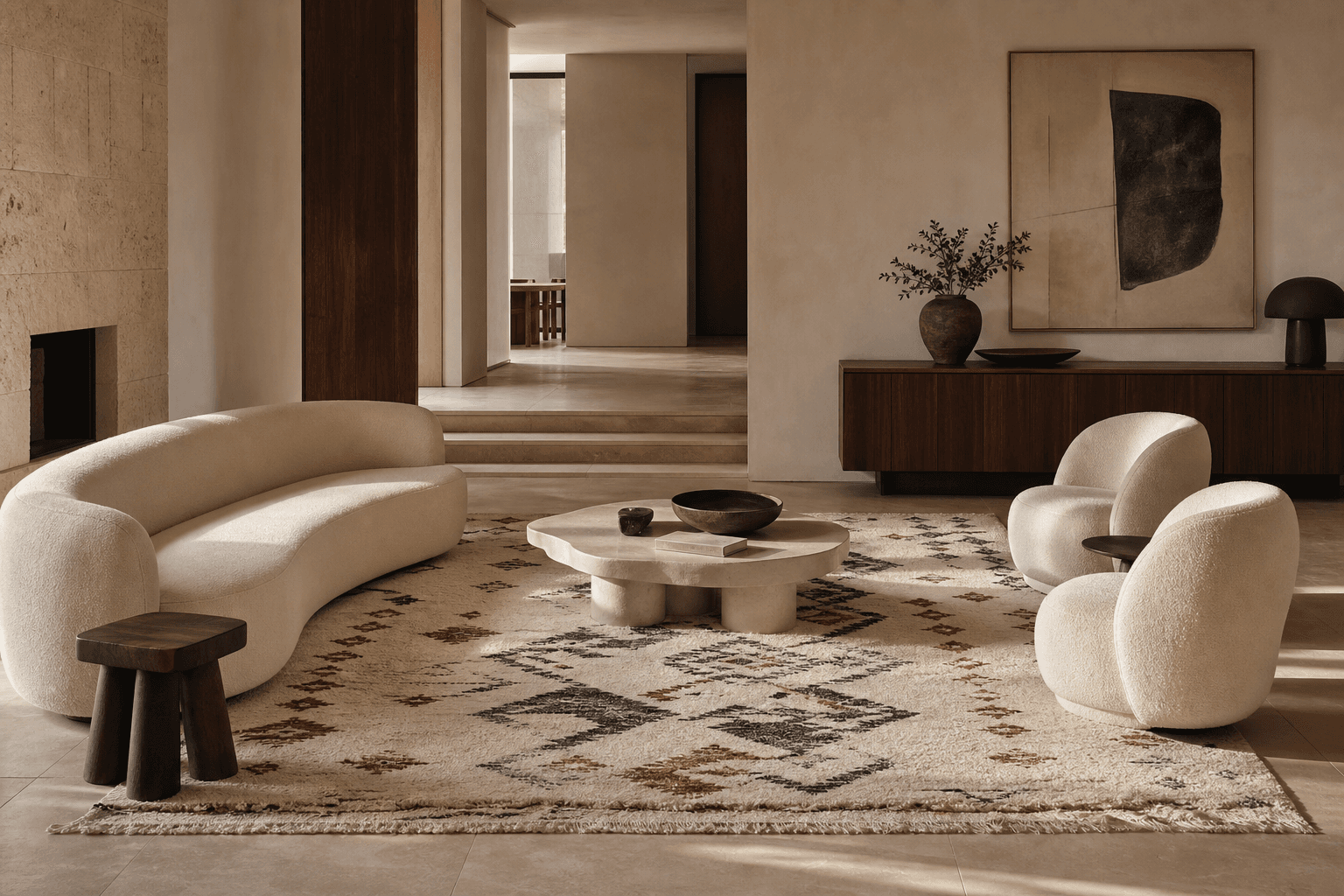
Change scale. A rug with broad stepped geometry can sit beneath artwork made of fine lines; a rug with many small marks can support one large abstract shape. Problems arise when rug, cushion, curtain, and art all use medium-scale motifs with similar contrast. The eye cannot identify a leader.
Change structure too. A geometric rug can pair with a botanical branch, hand-thrown vessel, or softly curved chair because form differs while color connects. Avoid reproducing the rug’s diamond in every accessory. One repeated shape can feel intentional; a room full of literal references reduces the original object to a motif kit.
If several rugs share an open plan, let each define a separate activity and vary pattern density. Keep a clear floor interval between them and repeat one background tone. The Rooms of the Archive demonstrate how red shadow, earthen neutrals, charcoal, and pale fields create distinct atmospheres without copying every element.
05 · Room by room
How should styling change by room?
Living room
Let the rug connect seating and set the room’s tonal center. Keep the coffee table open enough to reveal a central motif, and repeat one minor accent at eye level. Use side lighting to show pile rather than adding several patterned cushions.
Bedroom
Prioritize touch and the view from the doorway. A quiet rug can begin below the nightstands and extend around the bed; a stronger one may sit fully visible at the foot as a separate object. Keep bedding materially rich but pattern-light when the rug is expressive.
Dining room and study
Verify chair movement and pile before color. A strong central field can give a table gravity; in a study, a dark or earthen rug can ground books, timber, and focused light. Protect wool from rolling chair abrasion and choose a pad compatible with the floor. Use the care guide before placing high pile in a demanding zone.
06 · Light & editing
Let the room change without restyling the rug
Wool is not visually fixed. Side light catches pile direction, makes one half of a tonal field appear darker, and reveals hand variation that disappears under flat overhead light. Before adding accessories, observe the rug in morning, midday, evening, and artificial light. The room may already have enough movement once natural light begins to work across the surface.
Use lamps to support material rather than spotlight the rug like a display. A low floor or table lamp can graze pile and warm a reading zone; diffuse ceiling light keeps a dining rug legible without creating harsh contrast. Check whether strong sun reaches the same area daily and rotate the rug according to its care guidance.
Edit seasonally through small materials
In warm months, remove heavy throws and let linen, pale wood, ceramic, and the rug’s open field carry the room. In cooler months, add one dense textile, darker timber object, or wool throw that repeats a minor rug tone. Avoid replacing every cushion by season; a stable rug should support subtle shifts rather than demand a new scheme.
Photograph before adding
A phone photograph compresses the room and makes repeated color or pattern easier to see. Convert one image to grayscale to assess tonal hierarchy. If rug, sofa, floor, and table merge, adjust contrast. If several motifs demand attention, remove one accessory before buying another. Editing is usually more powerful than completion.
Allow useful emptiness
Bare plaster, visible floor border, an unfilled table surface, or one wall without art gives a patterned rug room to remain specific. Empty space is not unfinished when it clarifies material and circulation. A collected interior becomes convincing through intervals as much as through objects.
The final test is whether the room still works when removable styling disappears. Take away cushions, flowers, books, and decorative ceramics. If architecture, furniture, and rug still form a calm composition, the styling layer can remain light. If the room collapses, return to scale, alignment, and visual weight before adding detail.
Sound and scent also affect the finished atmosphere. Thick wool can soften reverberation in rooms with stone, glass, and high ceilings; clean dry natural textiles create a different sensory field from heavily fragranced treatments. Avoid perfuming a rug to complete a mood. A persistent odor is a care or condition question that styling should never conceal.
Live with the arrangement for a week before making final accessory purchases. Notice which seat people choose, where feet land, whether the coffee table hides the motif, and which objects are constantly moved out of the way. Styling becomes credible when it follows behavior. A beautiful photograph is a useful test, but a room that supports repeated ordinary actions is the real finished work.
The styling principle