An area rug anchors a room when it creates one legible relationship between furniture, circulation, and the room’s focal point. It does not need to fill the floor. It needs to touch enough of the seating group, repeat a consistent alignment, and carry enough visual weight that the furniture no longer appears to float as separate objects.
The anchor test
Can the rug explain the room from the doorway?
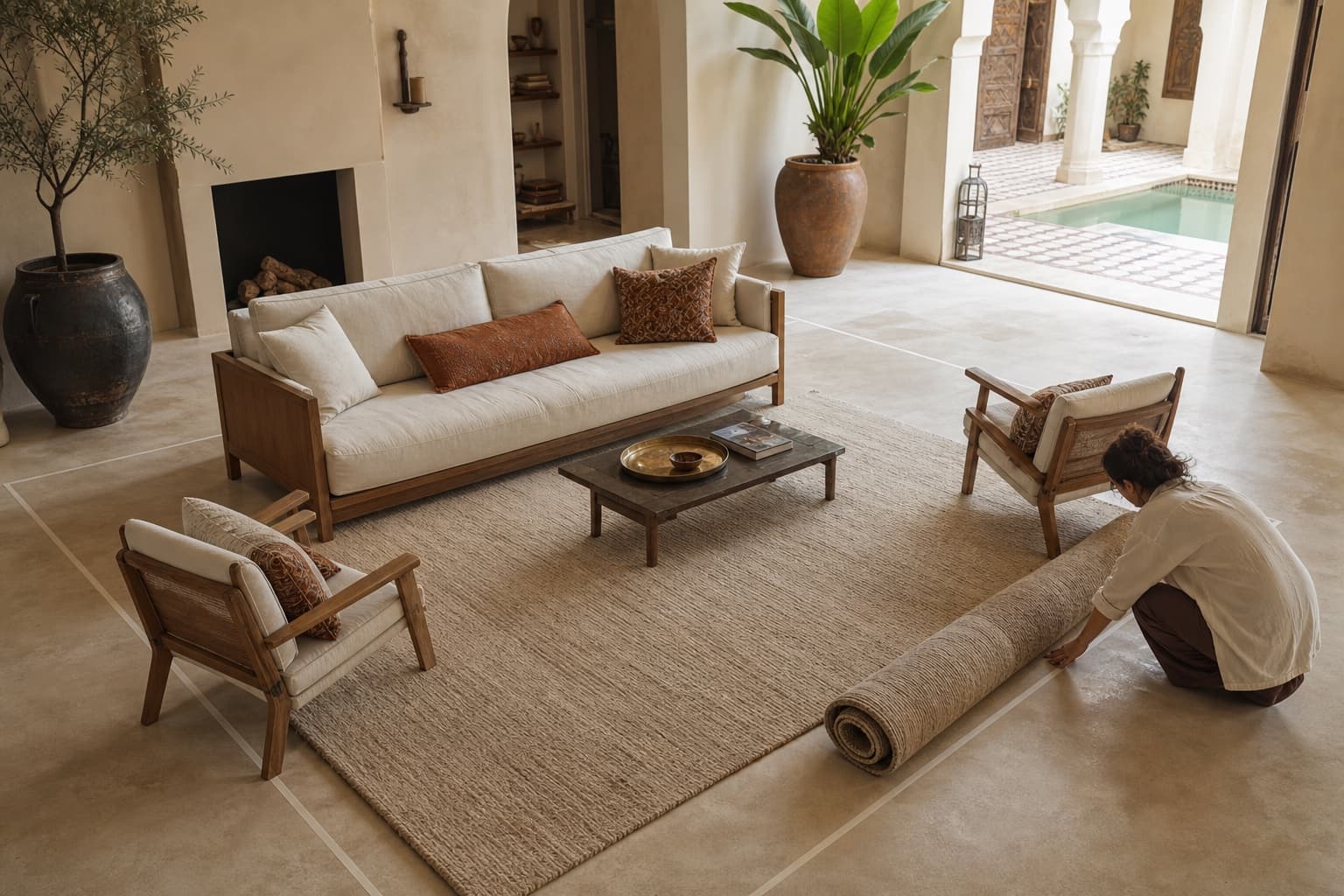
Stand at the main entrance. The sofa, chairs, and table should read as one group because they share the rug’s boundary. If the rug sits under only the coffee table while every seat remains outside it, the composition often fragments.01 · Boundary
Connect the furniture before choosing a focal point
Begin with the seating group, not the center of the empty room. In a typical living room, place at least the front legs of the sofa and chairs on the rug. In a generous layout, place all legs on. In a compact reading area, a smaller rug may hold one chair, side table, and footstool. The rule is consistency: similar pieces should relate to the rug in similar ways.
The coffee table should sit comfortably inside the rug rather than defining its entire size. Leave enough wool around it for the seated furniture to feel connected. If the table nearly fills the rug, the rug reads like a mat for the table instead of architecture for the room. Our living-room size guide gives exact layouts; this article deals with visual composition after the dimensions work.
Keep circulation outside the argument
Mark the paths people actually walk: door to sofa, hall to garden, kitchen to dining table. A rug can define a zone without becoming an obstacle. Avoid placing one narrow edge where every foot must catch it. A pad can reduce movement, but the plan should already respect the route. Leave a clear, intentional border of floor rather than a series of accidental slivers.
02 · Visual weight
Decide whether the rug grounds or announces
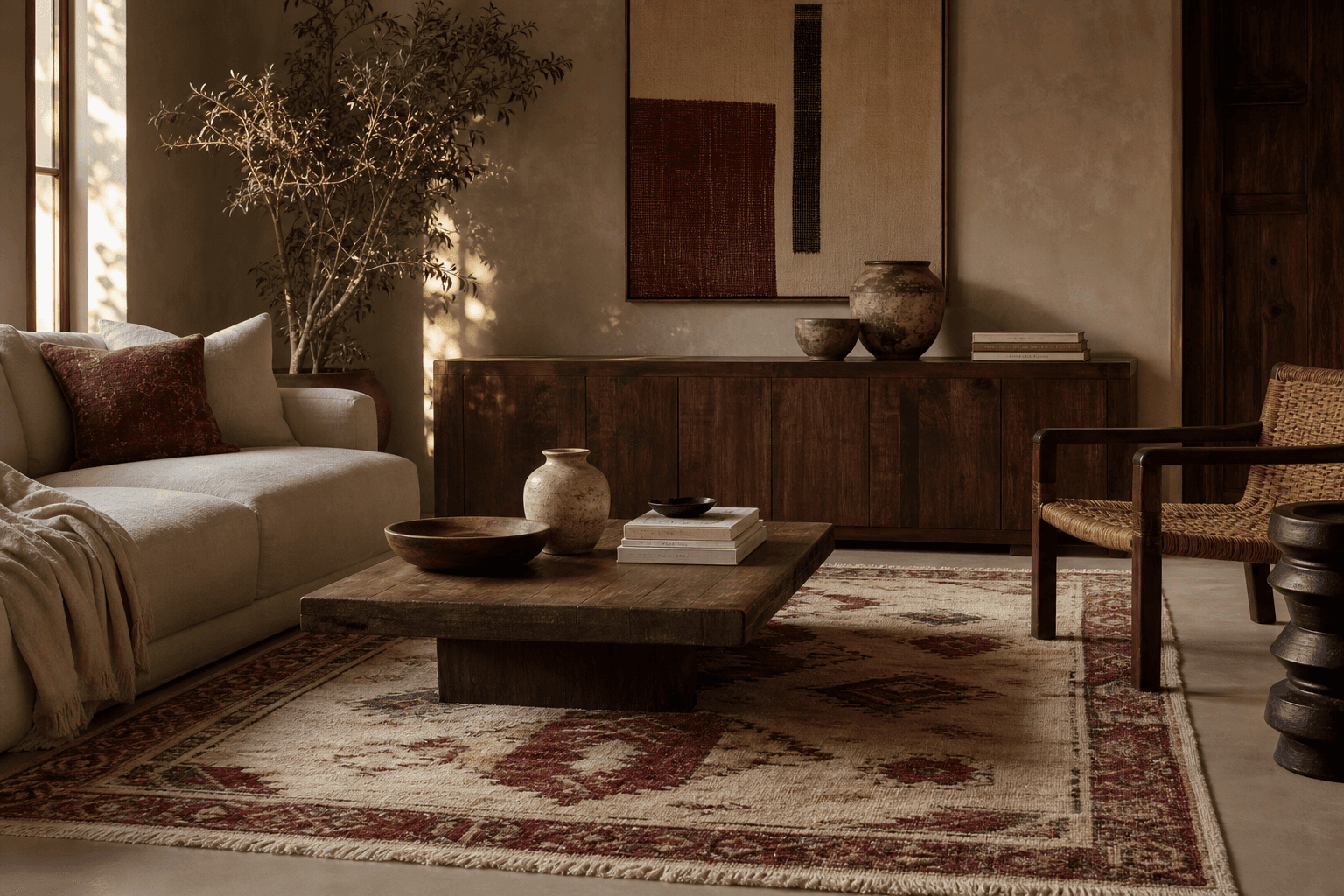
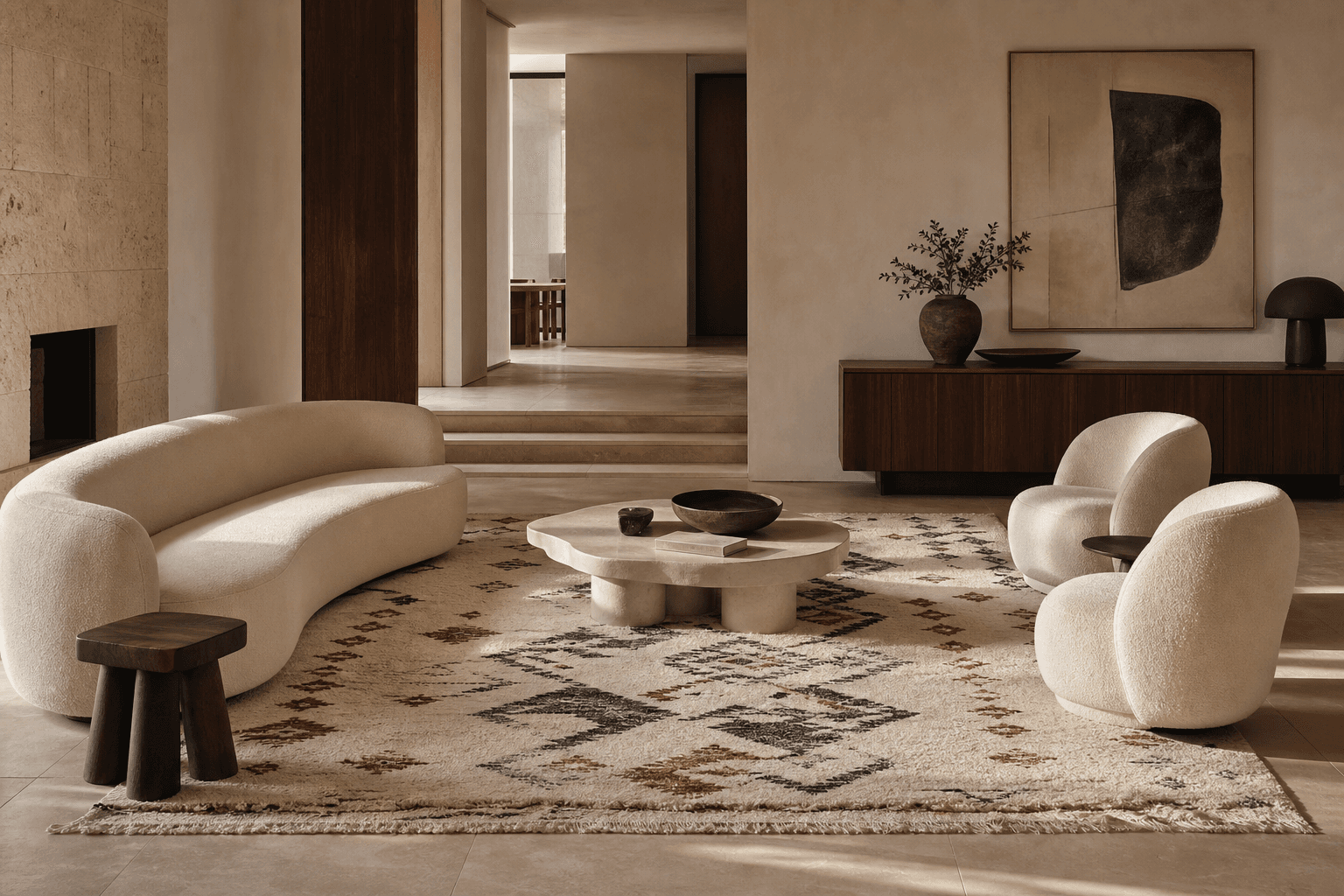
A dark or strongly centered rug pulls the eye downward and can stabilize pale furniture, high ceilings, or a room with many openings. A near-neutral rug lets art, architecture, and collected objects lead while still giving the furniture a tactile base. Neither is more sophisticated. The choice depends on where the room currently lacks weight.
Look for competition. A large fireplace, panoramic view, sculptural sofa, and strong rug can all ask to be the focal point. Choose one primary voice and let the others support it. If the rug carries a broad medallion, keep the coffee table visually quiet and avoid placing another dense pattern directly above it. If the rug is tonal, the room can accept a stronger artwork or chair.
03 · Alignment
Use sightlines, not only symmetry
Centering the rug in the room can be correct, but centering it on the active furniture group is often more useful. In an asymmetrical room, align the rug with the long sofa, the architectural opening, or the path toward the view. Let the composition acknowledge the building rather than forcing every object onto an imaginary central axis.
From the doorway, check whether a rug edge, table edge, and sofa front form calm parallel lines. They need not be mathematically exact, but accidental near-alignments create visual unease. In a room with an angled chair, keep the main rug and sofa square, then let the chair break the grid intentionally. One controlled exception feels alive; several small misalignments feel unresolved.
Open plans need one purpose per rug
Use separate rugs only when they define separate activities: dining, conversation, reading. Do not scatter rugs simply to fill bare floor. Each should have a clear relationship with its furniture and enough space from the next rug to read as a distinct zone. Repeat one material or quiet color across zones without using identical designs.
04 · Scale
What if the rug you love is too small?
First, test a more intimate function. A five-by-eight-foot rug that floats in a large salon may perfectly anchor a reading pair, a library conversation, or the foot of a bed. Moving the rug to the right zone is usually better than stretching a large seating plan around it.
Layering can work when the base is materially quiet and large enough for the furniture group. Place a flat, low-contrast natural-fiber rug beneath and center the smaller wool piece where its motif matters. Check that the combined edges remain stable, that the height change is safe, and that both materials can be cared for appropriately. Layering should solve scale, not disguise it.
Do not buy a rug on the assumption that “almost” will become convincing. Tape the exact outline, leave it for a full day, pull chairs, open doors, and photograph the room from its entrance. If the group still appears disconnected, choose another zone or a larger object.
05 · Five moves
Anchor the room in five deliberate moves
- Name the zone.Conversation, dining, reading, sleeping, or transition—not “the empty floor.”
- Measure the furniture group.Include chair movement and the front legs of every seat.
- Choose visual weight.Decide whether the rug should ground, glow, or become the focal point.
- Align the long edges.Use the sofa, table, opening, or main sightline as the governing line.
- Test from the doorway.The room should read as one composition before you notice individual objects.
After the layout works, move to color and texture. The Moroccan rug styling guide explains how to repeat one accent, mix material, and control pattern without weakening the anchor you have just created.
06 · Room scenarios
How does anchoring change outside a standard salon?
A long, narrow living room
Do not center one small rug in the architectural rectangle and leave furniture stranded at both ends. Define the main conversation zone with a rug large enough to connect its seats, then use a console, lamp, artwork, or secondary reading chair to give the remaining length a purpose. A rug with vertical rhythm can reinforce the long axis, while a broad central form can visually shorten it.
A square room with a corner fireplace
Align the primary rug with the seating group, not necessarily with all four walls. Let the sofa or pair of chairs acknowledge the fireplace through angle or sightline while the rug remains a stable rectangle. Avoid rotating the rug diagonally simply to point at the hearth; that often creates difficult edge conditions and disconnected furniture.
A room with a panoramic view
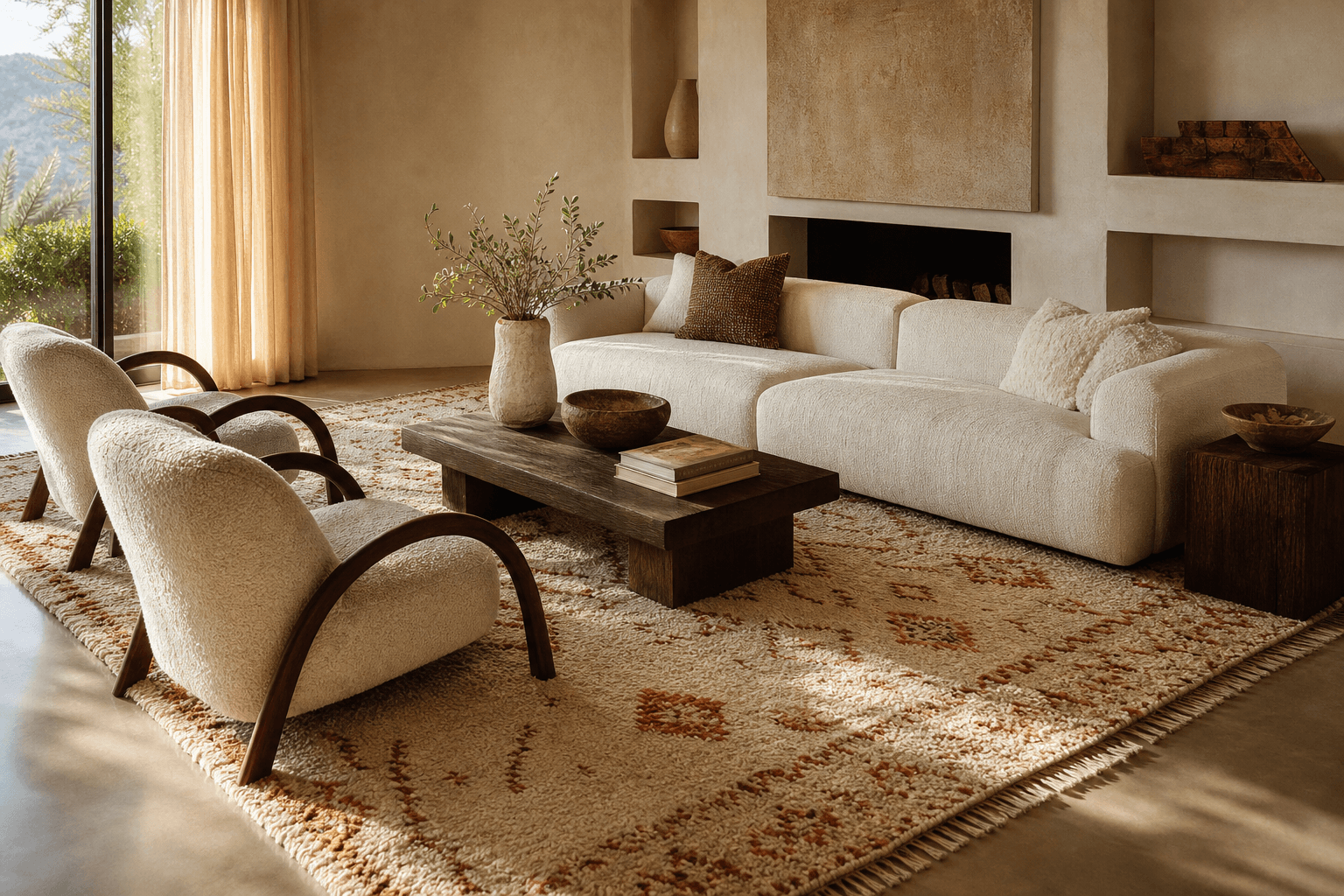
Keep the view as the main focal point and use the rug to quiet the foreground. A tonal field can connect low seating without competing with landscape. If the rug has a strong center, place it where the form leads toward the view rather than stopping circulation. Check the composition from both the entrance and the principal seat.
A small apartment
One generous rug can make a compact living zone feel larger by allowing several furniture pieces to share a surface. Several small rugs can divide an already limited floor into fragments. Use a consistent bare-floor border, keep door paths clear, and choose a coffee table that reveals enough of the field to maintain continuity.
A bedroom sitting area
Treat the bed and seating as separate zones only when the room has enough space between them. A five-by-eight rug may be too small beneath a large bed yet ideal beneath two chairs and a table at the window. The object anchors the activity it can fully support instead of becoming an undersized compromise elsewhere.
In every scenario, photograph the taped outline from eye level and from the threshold. Plans explain dimension; photographs reveal hierarchy, sightline, and whether the rug actually gives the room one readable center.
Repeat the test with ordinary life restored: side tables, reading lamps, open doors, charging cables, and the chair someone actually pulls toward the conversation. Editorial rooms can hide the small interruptions that determine whether an anchor survives daily use. The right rug does not require the room to remain staged; it keeps the group coherent after people begin moving through it.
If the room supports several layouts, test each with the same taped rug outline. A rug that works only when every chair is pushed against a wall is not truly anchoring the preferred arrangement. Compare conversation distance, access to side tables, view lines, and the amount of front-leg contact. The winning plan should feel natural from several seats, not only balanced in one photograph.
The anchoring principle